Vanguard's latest modelling suggests international equities could deliver stronger returns than US stocks over the coming decades, a forecast that has renewed interest in global diversification and placed the Vanguard Total International Stock ETF (VXUS) in the spotlight after the ETF outperformed the S&P 500 over the past year.
Why Vanguard's outlook matters
Vanguard's Capital Markets Model, updated to 30 June, projects annualised returns for international stocks outside the United States (unhedged) of 5.9% to 7.9% over a very long horizon. By contrast, the model expects US stocks to return 4.7% to 6.7% per year over the next 30 years. Those ranges imply international equities could outperform by about 1.2 to 2.2 percentage points annually if Vanguard's assumptions hold.
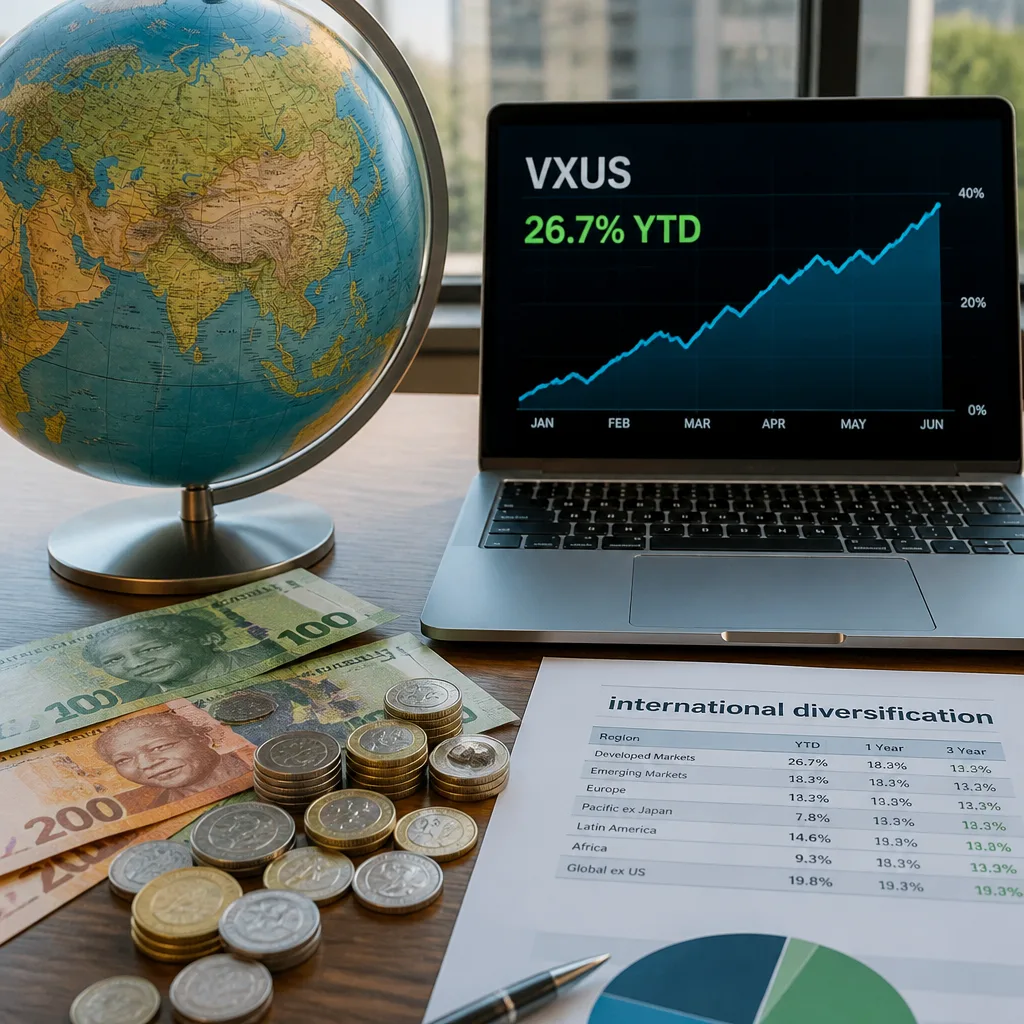
Motley Fool reported the research and highlighted the Vanguard Total International Stock ETF — ticker VXUS — as a practical vehicle for investors seeking exposure to companies outside the US. The ETF returned a total of 26.7% over the past year, exceeding the performance of America's large‑cap S&P 500 index during the same period, according to the report.
What VXUS holds and why that matters
VXUS is broadly diversified geographically and by company size. The ETF's portfolio contains 8,772 stocks from dozens of countries outside the US. Motley Fool emphasised that such breadth contrasts with the S&P 500's heavy concentration in a few large US technology companies that have driven recent market gains.
Two features of VXUS drew attention in the coverage:
- Scale of diversification: holding thousands of international names can reduce single‑market risk and offer exposure to regional economic recoveries and secular trends.
- Valuation: the ETF's trailing 12‑month price‑to‑earnings ratio was reported as 18.44, presented as lower than some US large‑cap benchmarks.
| Metric | Value |
|---|---|
| Vanguard model – International stocks (30 years) | 5.9%–7.9% pa |
| Vanguard model – US stocks (30 years) | 4.7%–6.7% pa |
| VXUS – number of holdings | 8,772 stocks |
| VXUS – trailing 12‑month P/E | 18.44 |
| VXUS – 1‑year total return | 26.7% |
Implications for South African investors and funds
The Vanguard projection and VXUS's recent performance underscore familiar portfolio decisions: how much to allocate offshore, whether to hedge currency risk and how to balance exposure between developed and emerging markets. For South African retirement funds, asset managers and private investors who already allocate overseas, the numbers provide fuel for re‑evaluating weights toward non‑US equities.
Motley Fool's coverage argued that one driver of the projected shift is the diffusion of technology gains. While many early benefits from artificial intelligence have accrued to US tech firms, Vanguard's model and the commentary suggest the largest productivity gains over the next two decades could be realised by a wider set of companies worldwide as they adopt and implement AI to improve operations.
That dynamic could give non‑US companies a path to share in AI‑enabled growth even if they were not the first developers of the technology. VXUS, with its broad basket, is positioned to capture gains from firms that benefit from such adoption.
Investors should note Vanguard's projection is a modelled expectation, not a guarantee. The Motley Fool report explicitly cautioned that the estimates are not certain and that market conditions, geopolitical events and currency movements will affect outcomes.
Still, the research has practical effects: it may prompt South African investors to reassess offshore diversification strategies, revisit currency hedging decisions and examine passive vehicles that offer broad international coverage. For pension funds and individual savers focused on long‑term outcomes, even a modest annual difference compounds significantly over decades — which is precisely the time horizon Vanguard's model addresses.