
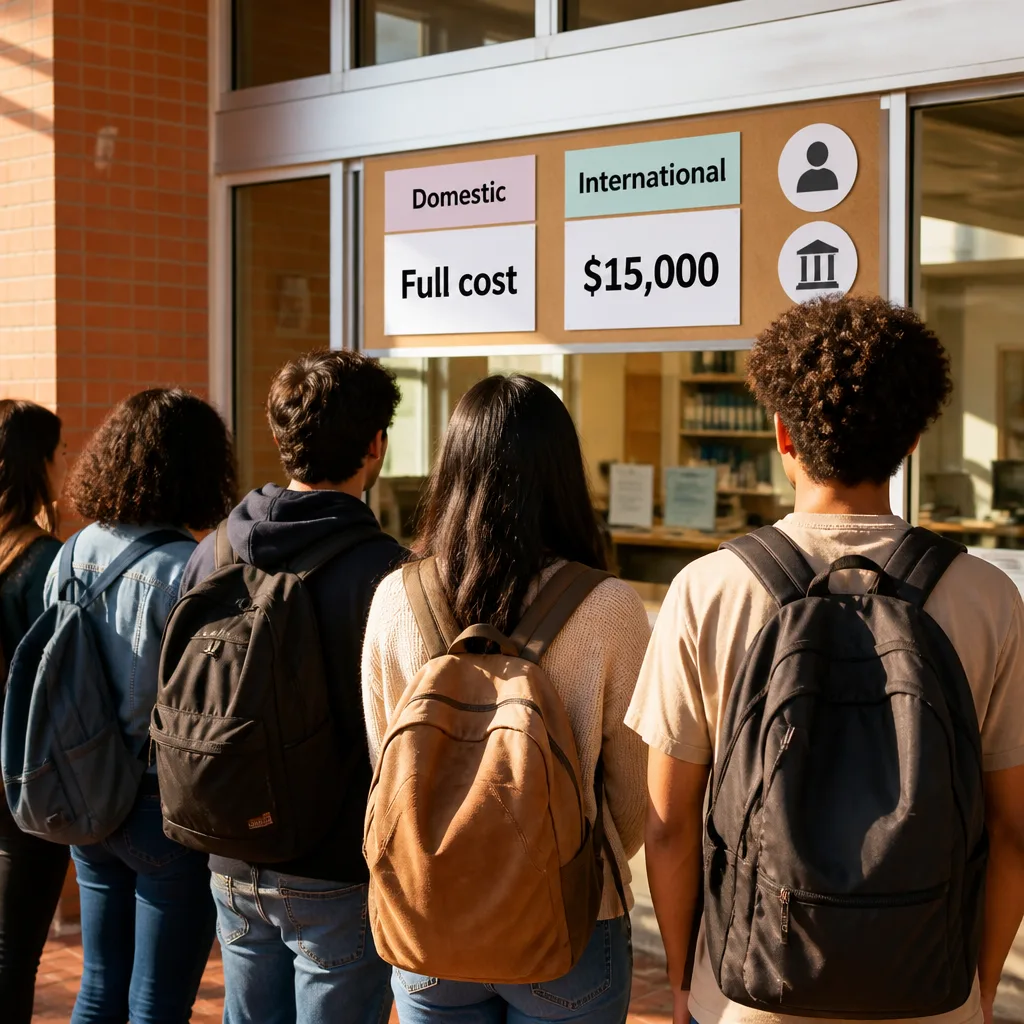
Harvard University’s newly adopted preferred-lender programme provides domestic graduate students broad access to borrow up to the full cost of attendance, while placing international students under sharply divergent annual loan caps depending on their faculty, raising concerns about funding shortfalls for those from abroad.
Who is affected and how
Under the revised arrangement, the University selected two lenders as its preferred partners: the Harvard Federal Credit Union (HFCU) and College Ave. Domestic students retain borrowing options that closely mirror the financing once available through the federal Grad PLUS loan. International students, who were already ineligible for Grad PLUS, now face ceilings that vary markedly across Harvard’s graduate schools.
Examples in the University’s new structure include:
- Harvard Law School, Harvard Medical School and Harvard Business School: international students can borrow up to the full cost of attendance from HFCU.
- Harvard Graduate School of Design (GSD): students face a limit of $15,000 despite a standard annual cost of attendance above $104,000.
- Harvard Graduate School of Education (GSE): international students are capped at $26,000 while the annual cost of attendance is roughly $106,000.
The University also set broader category caps: students in certain professional programmes such as law, medicine and dentistry may borrow up to $50,000 a year, while other graduate students are limited to $20,500 annually.
Why this matters
The changes come after the federal Grad PLUS loan was largely eliminated for students beginning new graduate programmes after 1 July. Grad PLUS previously allowed eligible domestic students to borrow up to the cost of attendance minus other aid; international students were ineligible for that federal product. With the federal option curtailed, Harvard’s choice of preferred lenders and the caps they impose have become a central mechanism for bridging the financing gap — or leaving it unfilled for many international students.
The impact is practical and immediate: in schools where institutional financial aid is limited and costs exceed six figures, capped loan access can force international students to seek alternative private lenders or to scale back study plans. That dynamic has implications for Harvard’s ability to attract a diverse international cohort and for prospective students weighing whether pursuing study at particular Harvard schools is financially feasible.
Institutional process and transparency
The University moved from publishing a neutral list of lenders to actively selecting two “favourable” lenders for the 2026–27 academic year after evaluating proposals from 22 companies. The process narrowed the field but also concentrated borrowing options for international students in ways that produce uneven outcomes across faculties.
Observers and affected students point to a mismatch between published tuition and living-cost figures for some programmes and the new borrowing ceilings. Where institutional scholarships are limited or non-existent, the difference between the available loan amount and the actual cost can be substantial.
| Graduate School / Category | Approx. annual cost (where stated) | International student loan cap |
|---|---|---|
| Harvard Law School / Medical / Business | — | Up to full cost of attendance (via HFCU) |
| Graduate School of Design (GSD) | More than $104,000 | $15,000 |
| Graduate School of Education (GSE) | Roughly $106,000 | $26,000 |
| Qualifying professional programmes | — | $50,000 |
| Other graduate students | — | $20,500 |
Students previously had access to a wider set of private lenders listed by the University; the new preferred-lender approach concentrates students’ choices. Where caps do not meet total costs, students may need to secure private financing beyond the preferred lenders, with potentially different rates and terms.
The policy shift follows a broader national reduction in federal graduate loan availability and highlights the growing role university-selected lending relationships play in facilitating — or constraining — international access to US graduate education.