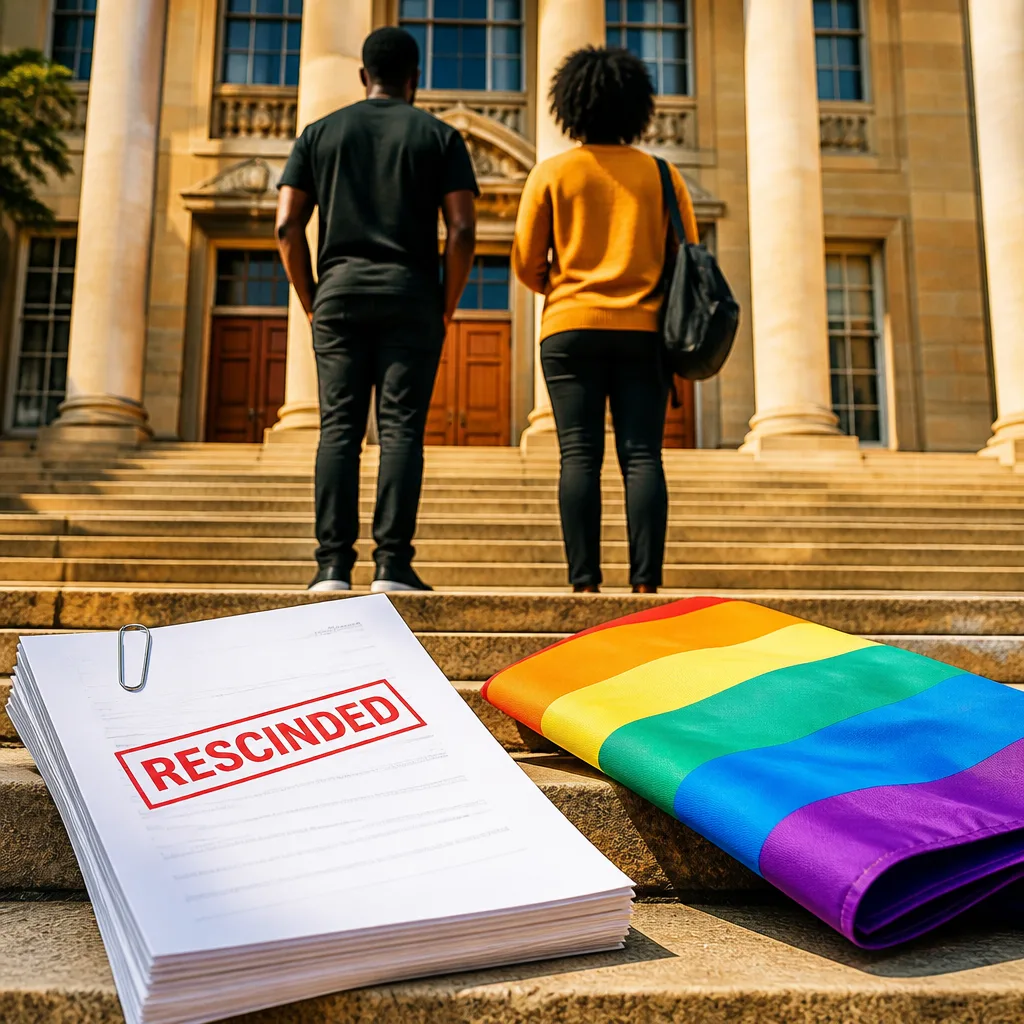
The US Department of Education has formally rescinded the 2024 Title IX regulations that for the first time had explicitly extended protections against sex‑based discrimination to include gender identity and related protections for LGBTQ+ students and school employees. The department said the revocation takes effect on publication in the Federal Register.
What the department says
According to the department, the 2024 rule was already not being enforced for more than a year and a half and had been preliminarily enjoined by eight courts in 2024, with two courts vacating the rule in early 2025. The agency cited those court decisions in announcing the repeal and said reinstating the previous regulatory language restores the approach taken under the earlier administration.
“Today’s rulemaking clears the Biden Administration’s illegal rewrite of Title IX from the Code of Federal Regulations and restores the commonsense language promulgated in the first Trump Administration, which we have been enforcing since the first days of the Administration,”
The department attributed the remark to US Secretary of Education Linda McMahon in a statement released ahead of the rule’s publication.
Process and timing
The department said it would rescind the 2024 regulation without opening a public notice and comment process, arguing that a new comment period would be "contrary to the public interest" because it would delay an update that reflects court rulings that are no longer subject to appeal. By the department’s own account, the 2024 rule had not been enforced for over a year and a half prior to the formal rescission.
The troubled 2024 regulation had been blocked by multiple federal courts after the Biden administration’s interpretation of Title IX — a federal law that prohibits sex‑based discrimination in education programmes that receive federal funds — to cover gender identity prompted litigation. Two courts subsequently vacated the rule in early 2025.
Implications for schools and students
The repeal returns regulatory text to the earlier version that the department says it has been enforcing since the first days of the current administration. That earlier text does not incorporate the 2024 regulation’s explicit language extending Title IX protections to gender identity in the same way.
The practical effect is to remove from the Code of Federal Regulations the 2024 rule’s definitions and provisions that had broadened protections for LGBTQ+ students and school employees. How this will play out in individual complaints and institutional policies will depend on further federal and state litigation, administrative guidance and school‑level responses.
- Enforcement pause: The department acknowledged it had not enforced the 2024 rule for over 18 months prior to rescission.
- Court actions: Eight courts issued preliminary injunctions in 2024; two courts vacated the 2024 rule in early 2025.
- Administrative move: The department rescinded the rule without a public notice and comment process, citing finality of court decisions.
| Item | Status |
|---|---|
| 2024 Title IX regulation | Formally rescinded on publication |
| Enforcement prior to rescission | Not enforced for over 18 months |
| Court injunctions/vacatur | Preliminary injunctions in eight courts; vacated by two courts |
The department characterised the 2024 rule as an "illegal rewrite" of Title IX language and said restoring the previous regulatory text aligns the Code of Federal Regulations with the rulings that concluded the 2024 text could not stand. Opponents of the 2024 rule celebrated the move as a restoration of the pre‑existing regulatory approach, while advocates who supported the 2024 protections have argued that removing explicit gender‑identity protections reduces legal clarity and safeguards for LGBTQ+ students.
For South African readers, the episode underscores how regulatory changes in large education systems can swiftly alter the landscape of student protections and how courts, administrative agencies and politics interact to shape education policy. In the US case, litigation at multiple levels and administrative decisions combined to leave the 2024 protections effectively dormant well before their formal removal.
How schools and higher‑education institutions respond to the rescission — whether through internal policies, protective measures at campus level or renewed legal challenges — will determine the day‑to‑day consequences for students and staff affected by sex‑based discrimination claims.