
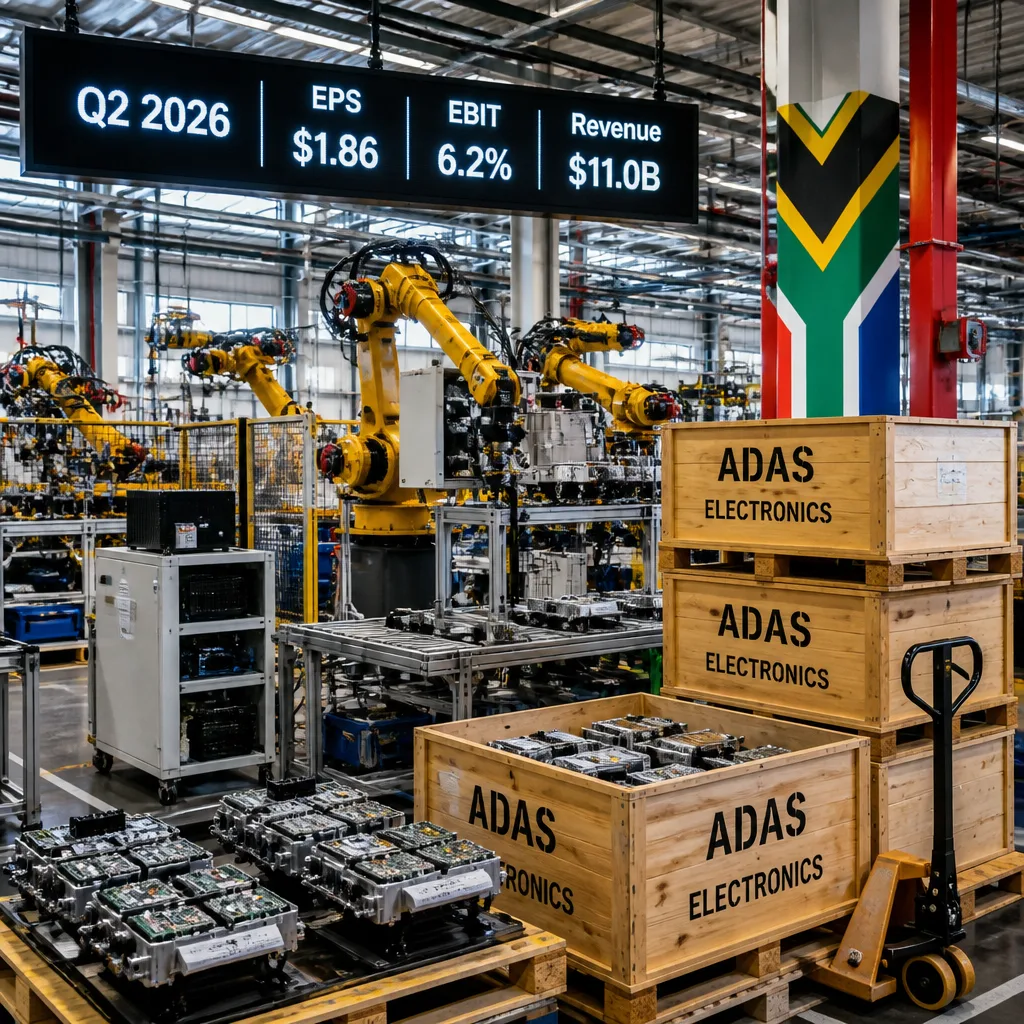
Magna International, one of the world’s largest automotive suppliers, reported a stronger-than-expected second quarter on 2 August 2026, posting record adjusted earnings per share and a rebound in profitability that underpins a renewed investor case for margin repair in the auto-parts sector.
Key results point to improving profitability and cash flow
The company delivered adjusted earnings per share of US$1.86 for Q2 2026, a quarterly record, and reported an adjusted EBIT margin of 6.2%. Revenue rose modestly to US$11.0 billion from US$10.63 billion a year earlier, while net income increased to US$482 million from US$379 million in Q2 2025.
Magna also generated substantial operating cash: free cash flow of US$617 million in the quarter. Management’s capital discipline kept capital expenditure near 2.4% of sales, yet the company returned US$598 million to shareholders during the period.
- Revenue (Q2 2026): US$11.0 billion (up 3% year-on-year)
- Net income (Q2 2026): US$482 million (up 27% year-on-year)
- Adjusted EPS (Q2 2026): US$1.86 (up 29% year-on-year)
- Adjusted EBIT margin: 6.2% (improved by 70 basis points)
- Free cash flow: US$617 million
Why this matters beyond Magna
The quarter is significant for several reasons. First, the results provide evidence that some large tier‑one suppliers can start to restore margins after a multi‑year squeeze driven by commodity volatility, pandemic disruptions and shifting vehicle mixes. Second, Magna flagged growth in higher-value areas such as electronics and advanced driver assistance systems (ADAS), which can lift content per vehicle and support higher margins.
Investors had already been pricing in a gradual margin recovery for the sector. The company’s earnings print, however, showed a sharper rebound in profitability and cash generation than many expected — a development that can influence valuations and capital allocation across the industry.
| Metric | Q2 2026 | Q2 2025 |
|---|---|---|
| Revenue | US$11.0 billion | US$10.63 billion |
| Net income | US$482 million | US$379 million |
| Adjusted EPS | US$1.86 | US$1.45 |
| Adjusted EBIT margin | 6.2% | 5.5% |
Implications for industry trends and investors
Magna’s performance illustrates two industry dynamics that matter for markets and policy makers. Higher electrical and electronic content — particularly in ADAS and driver monitoring systems — is shifting supplier revenue mixes. Where content per vehicle rises, suppliers can capture stronger margins if they manage costs and capital effectively.
Second, the ability to produce strong free cash flow while keeping capex restrained suggests a return to tighter capital discipline among established suppliers. For investors, the combination of margin improvement and cash generation supports casework for re-rating some stocks after a prolonged period of structural and cyclical headwinds.
Magna’s shares had risen in preceding months as investors positioned for a recovery. The Q2 results now test whether market optimism is sustainable across the sector or concentrated among firms with particular exposure to electrification content and operating leverage.
The company trades on the Toronto Stock Exchange under the ticker TSX:MG and its quarterly update will be watched closely by participants assessing the global auto supply chain’s path to healthier profitability.
As the auto industry continues to reconfigure around electrification and software-defined features, results such as Magna’s offer an early barometer of which suppliers can adapt their cost bases and capture the value of higher-content vehicles.