
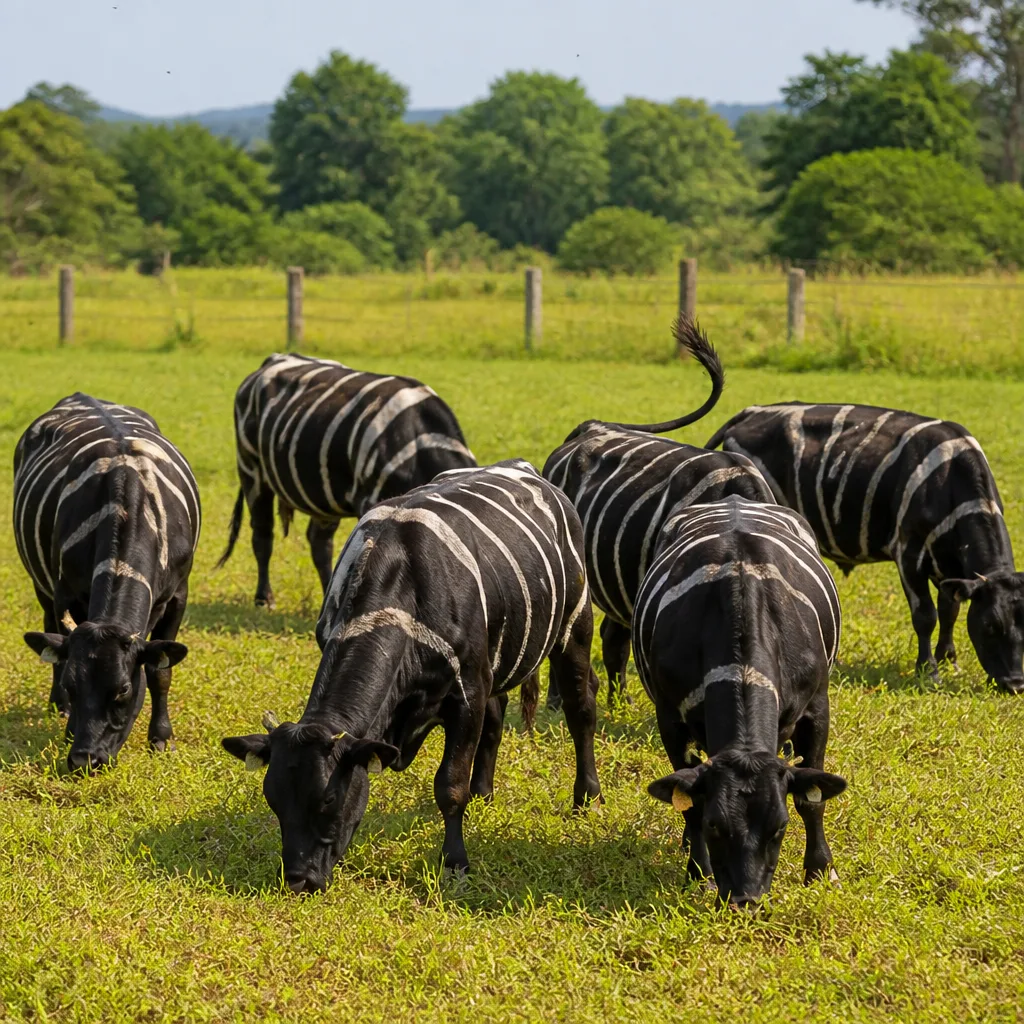
Painting black cows with white stripes reduced the number of biting flies on them by about 50%, according to a controlled field trial published in PLOS ONE in 2019. The experiment, led by Tomoki Kojima at the Aichi Agricultural Research Center in Japan, provides fresh support for the hypothesis that zebra striping functions primarily as a defence against insect pests rather than camouflage or thermoregulation.
Clean experimental design
Researchers used six Japanese Black cows — a uniformly dark breed — and exposed them, in rotation, to three treatments: painted with black-and-white zebra-style stripes; painted with black-only stripes (to control for the presence of paint); and left unpainted. Animals grazed on pasture where biting flies were common. Investigators photographed the cattle at set intervals and counted visible flies in the images.
The results were clear: cattle in the zebra-stripe condition carried roughly half the number of visible flies compared with the same animals when unpainted or when painted only with black. The striped cows also displayed substantially fewer of the behaviours cattle use to remove or deter flies — head throws, ear beats, leg stamps, skin twitches and tail flicks — indicating they were being irritated less.
- Treatment comparison: zebra-style paint versus black-only paint and unpainted.
- Outcome: approximately 50% fewer visible biting flies on striped animals.
- Behavioural effect: reduced fly-repelling actions in striped condition.
Implications for zebra evolution and livestock
For decades, biologists have debated why zebras have distinctive stripes. Explanations proposed over time include camouflage, confusion of predators, social signalling and regulation of body temperature. Many of these ideas have struggled to explain the persistence and specific patterning of stripes. The cow experiment strengthens the case that stripes act as an effective visual deterrent to biting flies — a selective pressure that could favour striping in equids.
Understanding the mechanism is important beyond natural history. Biting flies transmit pathogens and cause stress in livestock, reducing productivity and welfare. If the visual properties of striping — rather than scent or physical barriers — are responsible for discouraging flies, it opens possible avenues for non-chemical, low-cost interventions to protect animals from biting insects.
What the stripes might do to flies
While the 2019 study demonstrates an effect, it does not definitively identify the underlying visual mechanism. Previous research has suggested several possibilities: stripes may disrupt the ability of flies to land, interfere with polarised light cues, or create visual motion patterns that confuse insects. The Japanese study isolates the effect of patterning by controlling for the presence of paint, but further work is needed to pin down precisely how flies perceive and respond to the stripes.
Researchers also measured behavioural indicators on the cattle, which strengthen the case that fewer flies were interacting successfully with striped animals. That said, the experiment was conducted on a small number of animals in a specific setting; wider replication across environments, host species and fly taxa will be required to test how general the effect is.
Next steps and caveats
The study is an important contribution to a larger body of work examining stripe function. It complements laboratory and field experiments on insect landing behaviour and sensory ecology. However, the trial does not address long-term costs or benefits of striping in wild equids, nor does it prove that fly avoidance was the original selective pressure that produced zebra patterns in evolution. Evolutionary explanations must integrate multiple lines of evidence, including fossil, genetic and ecological data.
For farmers and animal-health practitioners, the finding suggests that visual approaches deserve attention as part of integrated pest management. Any practical application would need rigorous testing for durability, safety and cost-effectiveness before adoption.
The experiment led by Kojima and colleagues therefore moves the debate forward: stripe patterns appear to do measurable work against biting flies under natural conditions, but more targeted research is required to translate that insight into broader ecological or agricultural conclusions.