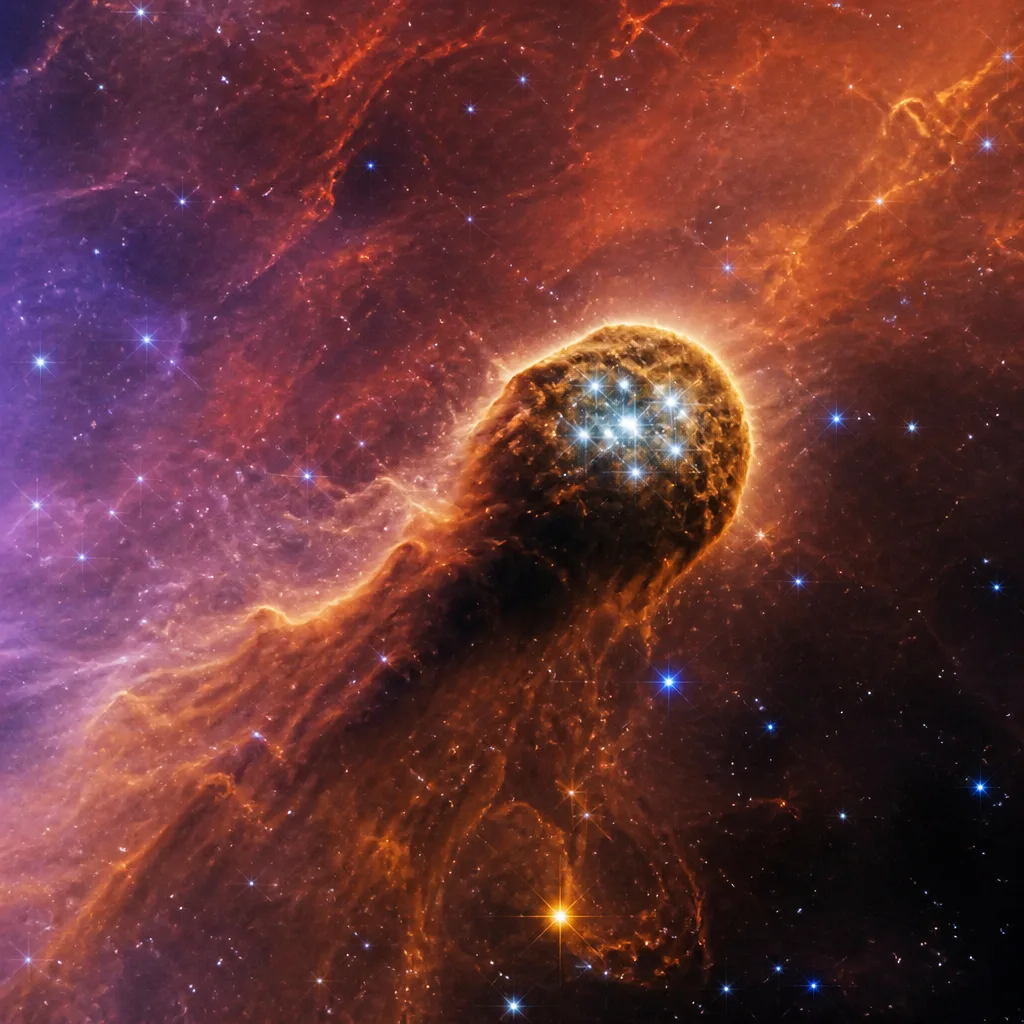
The James Webb Space Telescope has returned a striking near-infrared view of a compact star cluster embedded within the Carina Nebula, an active star-forming complex about 7 500 light-years from Earth. The feature, nicknamed the Treasure Chest, is a cometary globule — a dense, dark head of gas and dust with an extended tail — that shelters dozens of very young stars.
What Webb shows
Webb’s Near-Infrared Camera (NIRCam) reveals the Treasure Chest as a small, chest-shaped knot within the much larger Carina complex, which spans roughly 260 light-years. The telescope’s sensitivity to infrared light lets it peer through dust that blocks visible wavelengths, exposing both the glowing material around the newborn stars and details of the surrounding sculpted clouds.
Researchers estimate the compact cluster inside the globule contains about 70 stars. The most massive of these is identified as an O-type star with a mass close to 19 times that of the Sun. Because the cluster is very young and remains embedded in its natal dust, many of the individual stars show evidence of circumstellar discs — the reservoirs from which planets may eventually form.
Age and evolution
Published estimates place the cluster’s age at approximately 1.3 million years, though earlier work suggested it could be as young as 100 000 years. The range of ages reflects both the difficulties in dating deeply embedded stellar groups and the rapid environmental changes that massive stars impose on their birth clouds. As the cluster’s stars grow brighter and their radiation erodes surrounding material, the dust envelope will gradually disperse and reveal the full membership.
- Distance: 7 500 light-years from Earth
- Carina Nebula size: ~260 light-years across
- Cluster membership: ~70 stars
- Largest star: O-type, ~19 solar masses
- Age estimate: ≈1.3 million years (earlier estimate ≈100 000 years)
| Property | Value |
|---|---|
| Distance | 7 500 light-years |
| Region size | ~260 light-years |
| Approx. stars in cluster | ~70 |
| Most massive star | O-type, ~19 M☉ |
| Age (estimates) | ~1.3 million years; earlier estimate ~100 000 years |
Why astronomers care
The Carina Nebula is the nearest region that forms high-mass stars while offering a broad view of different stages of stellar birth. That proximity and diversity make it a natural laboratory to study how massive stars influence their surroundings — clearing cavities with radiation and winds, triggering or suppressing further star formation, and shaping the morphology of dust clouds into pillars, cavities and cometary globules.
Features such as the Treasure Chest complement Webb’s earlier, widely publicised images of the Cosmic Cliffs in Carina. Together, they illustrate how sensitive infrared observations can reveal both the embedded stellar population and the interplay between young stars and the interstellar medium.
Open questions
Although the new observations clarify the Treasure Chest’s contents, they also highlight uncertainties. The cluster’s true age distribution, the fraction of stars with long-lived circumstellar discs, and the future dynamical evolution of the compact group remain areas for follow-up study. Measuring disc properties and the impact of the massive O-type star on nearby lower-mass siblings will be key to understanding planet formation prospects in such extreme environments.
As Webb continues to map nearby star-forming regions, images like this one will refine models of how massive stars form and how they sculpt their birthplaces — processes that shaped the Milky Way and continue to govern stellar nurseries across the universe.