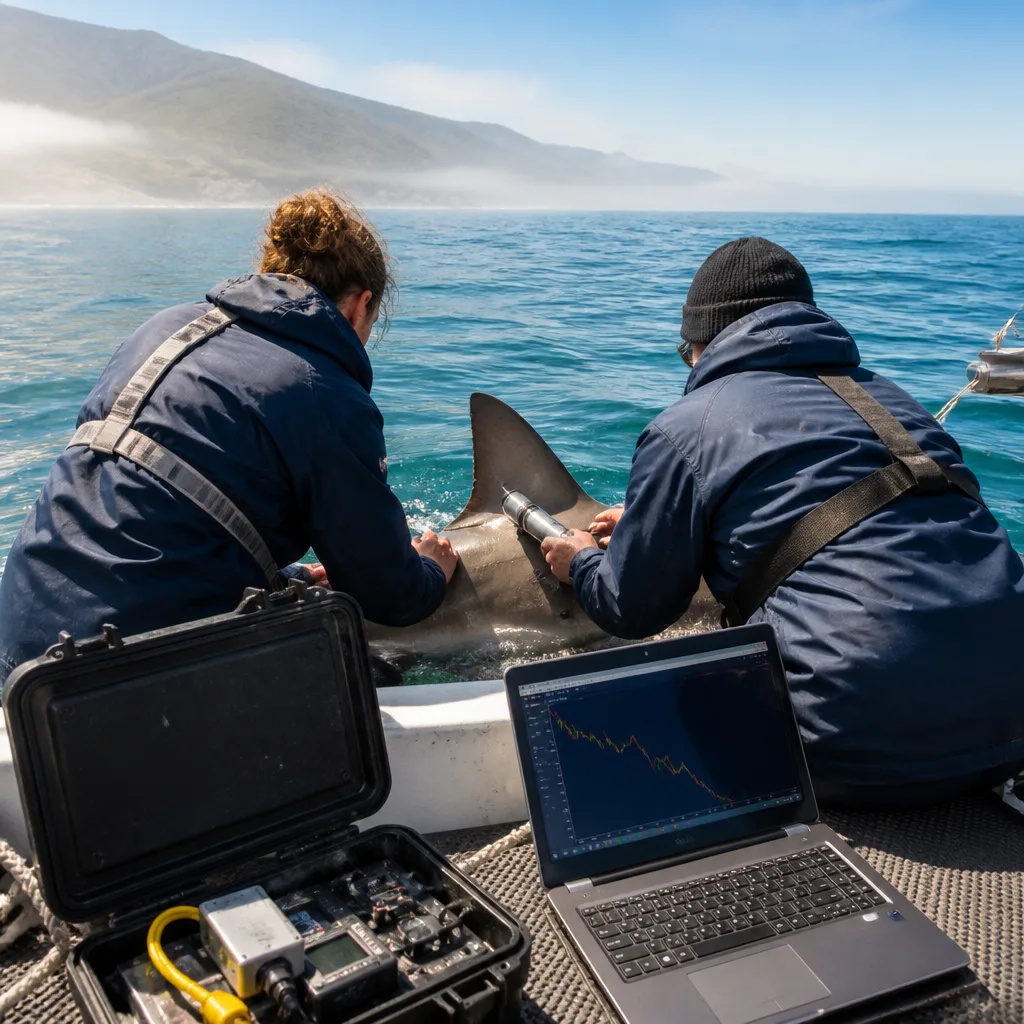
Scientists at the University of Delaware have begun attaching small electronic sensors to sharks off the US East Coast to gather near‑real‑time ocean data that could improve predictions of hurricane intensity.
Mobile ocean observers
The researchers are testing whether sharks can act as mobile ocean-data observers, transmitting measurements of temperature, depth and electrical conductivity — the latter used to infer salinity — as the animals swim and dive. The devices used are CTD tags (conductivity, temperature, depth), a technology long used by oceanographers when deployed from ships or attached to other marine animals.
According to the university's School of Marine Science and Policy, animal‑borne sensors have a precedent in polar regions, where tags on elephant seals have filled important observational gaps. The University of Delaware team argues sharks offer complementary advantages: they are abundant across wide ranges, often easier to access than protected marine mammals and include species that surface frequently enough to transmit data to satellites.
"We are really most interested in the heat content of the top layer of the ocean, which is known as the mixed layer," Aaron Carlisle, principal investigator and a professor at the School of Marine Science and Policy, said.
The mixed layer is the upper portion of the water column that exchanges heat with the atmosphere. Its temperature and heat content are critical to hurricane development because warmer surface waters supply energy that can intensify storms. The project aims to supply more timely and spatially distributed observations of this layer ahead of making landfall.
Candidate species and data transmission
Earlier analyses identified several shark species as promising platforms for CTD tagging in the North Atlantic, including:
- Shortfin mako
- Blue shark
- Smooth hammerhead
- Juvenile great white shark
The team selects individuals that are likely to collect measurements most useful to hurricane research and that surface often enough for the tag to break the water and transmit data to orbiting satellites. That near‑real‑time transmission differentiates shark‑borne sensors from archival tags that require recovery to download data.
| Measurement | Relevance to hurricanes |
|---|---|
| Temperature | Determines heat available to fuel storm intensification |
| Conductivity (salinity) | Affects density and stratification of the mixed layer |
| Depth | Locates the measurements within the water column |
Context and limitations
Animal‑borne sensors are not new to oceanography, but using sharks specifically to inform hurricane forecasts is a more recent avenue of research. The value of the approach depends on several factors: how well the spatial and temporal coverage of tagged sharks aligns with developing storms; the reliability of satellite data transmission when sharks surface; and how the observations are assimilated into oceanographic and atmospheric models used by forecasting agencies.
Researchers say the primary scientific goal is to better characterise the heat content of the mixed layer — a key variable for predicting whether a hurricane will strengthen or weaken as it approaches land. If shark‑borne data can be integrated effectively, they could complement existing platforms such as buoys, ships and remote sensing, particularly in areas or times when conventional observations are sparse.
Broader adoption would require systematic tagging campaigns, coordination with forecasting centres and assessment of any ecological or animal‑welfare implications of tagging. The University of Delaware team selects species and individuals with surface behaviour suited to satellite transmission and seeks to align sampling with periods of elevated hurricane risk.
The project illustrates a wider trend in ocean science: leveraging animal behaviour to extend observation networks in regions where instruments alone are insufficient. For countries facing growing hurricane and cyclone risks, improved estimates of ocean heat content ahead of storms could refine intensity forecasts and support earlier, more targeted preparedness measures.