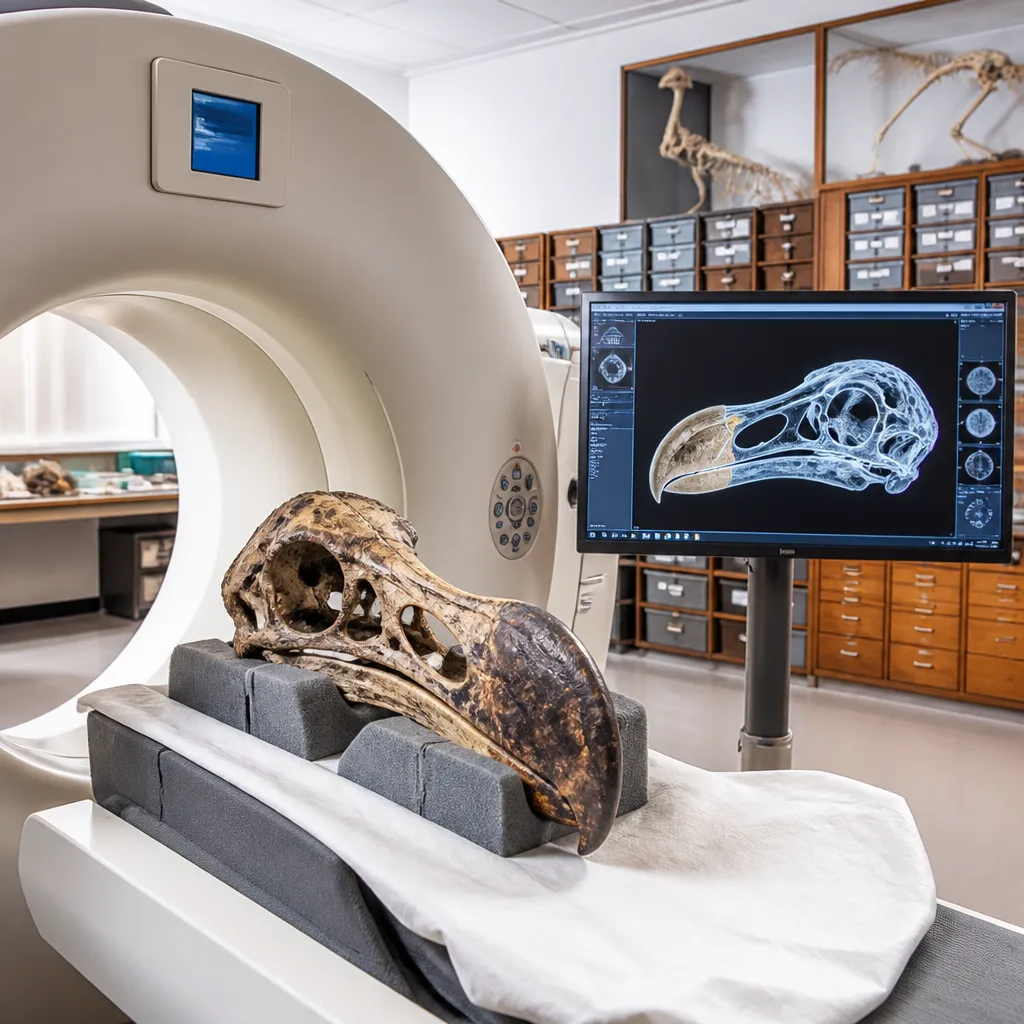
New digital reconstructions of the dodo's skull indicate the extinct bird's sensory world was more complex than long assumed, with evidence for a keen sense of smell, a highly sensitive upper beak and a capacity for activity that may have extended into dawn and dusk.
CT scans unlock rare specimen
Researchers led by the University of Lethbridge in Canada used high‑resolution CT scanning to examine the only two complete dodo skulls known to science. One specimen is housed at the Natural History Museum Denmark in Copenhagen and the other at the Oxford University Museum of Natural History. The Copenhagen skull, which has been part of the museum's collections for centuries, was scanned as part of preparations for a new museum building and permanent galleries due to open in 2027.
The imaging allowed scientists to build detailed digital reconstructions of the cranial cavity that once contained the dodo's brain and associated sensory structures. Comparison with the skull anatomy of modern pigeons and doves – the dodo's closest living relatives – revealed a series of differences that point to a distinct sensory profile.
Key sensory findings
- Enhanced olfaction: structures linked to smell were comparatively large, suggesting the dodo may have relied more on scent than its pigeon relatives.
- Sensitive beak: bone and cavity morphology indicate a capacity for heightened tactile sensation in the upper beak, which could have helped the bird probe for food.
- Flexible daily activity: cranial features are consistent with a lifestyle that was not strictly diurnal and may have included activity at dawn and dusk.
The team stresses that these anatomical inferences do not deliver a complete behavioural portrait but provide new, testable hypotheses about how the dodo foraged and navigated its environment on Mauritius before its extinction in the late 17th century.
"The dodo is one of the world's most recognisable extinct animals, yet surprisingly little is known about how it actually lived," said Peter Andrew Hosner, Associate Professor and Curator of Birds at the Natural History Museum Denmark and a co‑author of the study published in the Zoological Journal of the Linnean Society.
Context and caution
Only two complete skulls exist, so the study draws from an exceptionally small sample. The researchers compared the dodo's reconstructed braincase and sensory regions with those of living pigeons and doves to infer relative development of smell, touch and vision. Such comparative anatomy is a standard approach in palaeobiology but carries intrinsic limits: soft tissues, neural wiring and behaviour cannot be observed directly in extinct species and must be inferred from bony correlates.
Nevertheless, the findings challenge enduring, simplistic views of the dodo as a clumsy or sensory‑poor bird. Instead, the evidence points to a species adapted to detect food and interact with its environment in ways that differ from its volant relatives. A stronger reliance on olfaction and tactile probing of substrates would have important implications for reconstructing the dodo's diet, foraging strategies and habitat use on Mauritius.
Specimens and methods
The two complete skulls used in the study are kept in major European natural history collections. The Copenhagen specimen's scanning was enabled by museum redevelopment work, giving researchers access to exceptional imaging resolution.
| Specimen | Institution |
|---|---|
| Complete dodo skull | Natural History Museum Denmark, Copenhagen |
| Complete dodo skull | Oxford University Museum of Natural History |
The study was published in the Zoological Journal of the Linnean Society. Authors used CT data to reconstruct internal cavities and compare relative sizes of brain regions and sensory‑related structures, a method that has become increasingly important in studies of fossil and historic specimens where destructive sampling is not possible.
These new anatomical data will inform future work on the dodo's ecology and may prompt re‑evaluation of how human arrival and introduced species interacted with the bird's sensory abilities and behaviour during the island's ecological transformation.