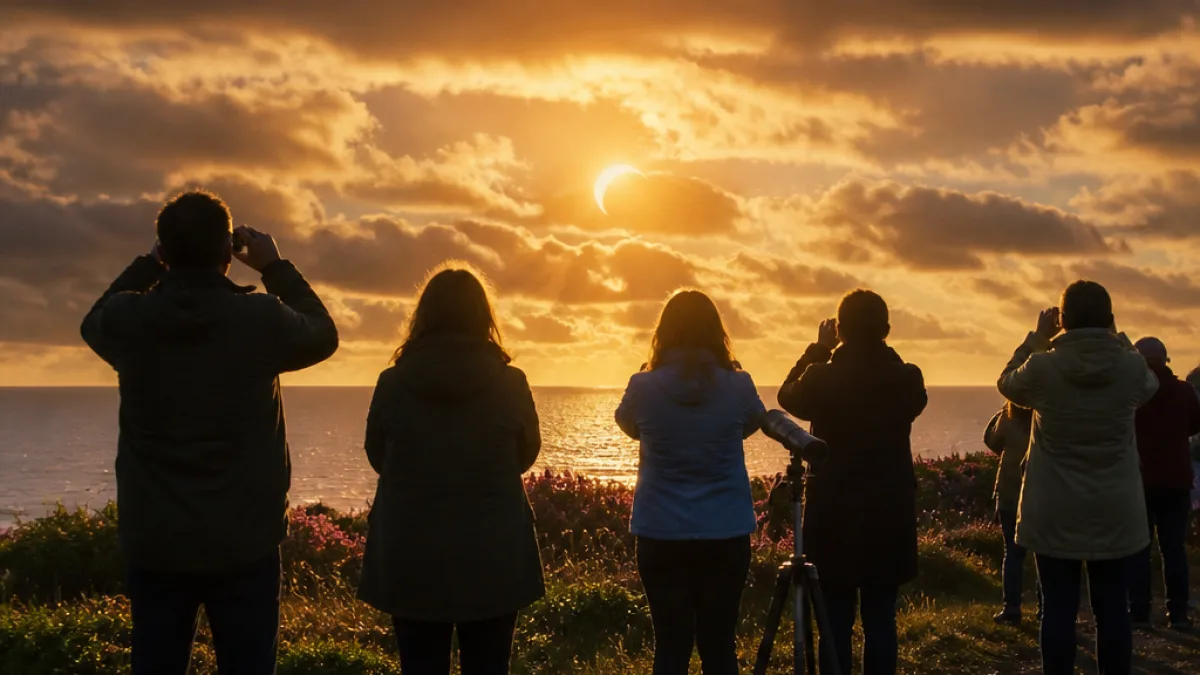
Millions across the UK and Ireland will witness an almost-total solar eclipse on Wednesday, the first event of its kind in more than two decades. The moon will pass between the Earth and the sun, obscuring the solar disc for most observers and creating a striking evening sight.
How much of the sun will be covered?
The proportion of the sun obscured will vary around the region. Western parts of the UK are set to see the greatest coverage:
- Plymouth – around 95%
- Cardiff – about 93.2%
- Belfast – about 93.1%
- Manchester – roughly 91.9%
- London – roughly 91.4%
- Edinburgh – about 90.7%
- Newcastle – around 90.2%
- Shetland – lowest coverage at about 88%
| Location | Estimated coverage |
|---|---|
| Plymouth | 95% |
| Cardiff | 93.2% |
| Belfast | 93.1% |
| Manchester | 91.9% |
| London | 91.4% |
| Edinburgh | 90.7% |
| Newcastle | 90.2% |
| Shetland | 88% |
Where to go for the best view
Astronomers recommend seeking elevated sites with clear western horizons so the setting sun (and the eclipse) are unobstructed. In London, for example, well-known vantage points include Parliament Hill, Alexandra Palace and Primrose Hill; similar hilltops and rooftop venues will serve observers in other cities.
“These are small differences, and all will still be impressive sights,” Royal Observatory astronomer Jess Lee said, urging people to find clear views to the west.
Weather will play a decisive role
The event falls in August, which increases the chance of a clear sky in many places, but forecasters caution there are regional risks. A Met Office meteorologist noted that current conditions make it too early to be certain, while indicating that much of the country could enjoy reasonable viewing given recent summer weather. At the same time, thick cloud and rain remain more likely over Scotland and Northern Ireland, and these areas face the highest chance of the eclipse being obscured.
Tom Morgan of the Met Office said it was too early to be confident, but “given the summer we’ve had a lot of the UK will have reasonable viewing conditions”.
Scotland’s astronomer royal underlined the importance of monitoring cloud cover forecasts and being ready to travel within the country to find clear skies.
“I plan to check the Met Office’s fantastic online cloud cover forecast as we get closer to the day. I’m ready to hop on a train north, south, east or west to find some cloud-free skies,” Catherine Heymans said.
Practical considerations for observers
- Find a high point with an unobstructed view of the western horizon.
- Check local cloud-cover forecasts close to the event and be prepared to move to clearer areas if possible.
- Remember that although the eclipse is almost total in parts of northern Europe, only small differences in coverage separate many locations — even 90% obscuration will be a dramatic sight.
Across north-western Europe generally, the obscuration will be substantial, with expected coverage of about 88–95% for most observers. Further afield, limited areas in Greenland, Iceland and northern Spain will experience a full total eclipse lasting up to two minutes and 18 seconds.
For those planning to watch the phenomenon, the combination of local viewing geometry and weather will determine how much of the sun is hidden. Observers are advised to follow official safety guidance for viewing the sun and to check updated forecasts and announcements as the day approaches.
Note: Times and precise percentages vary by location; readers should consult local astronomical societies or national meteorological services for the latest, location-specific information.