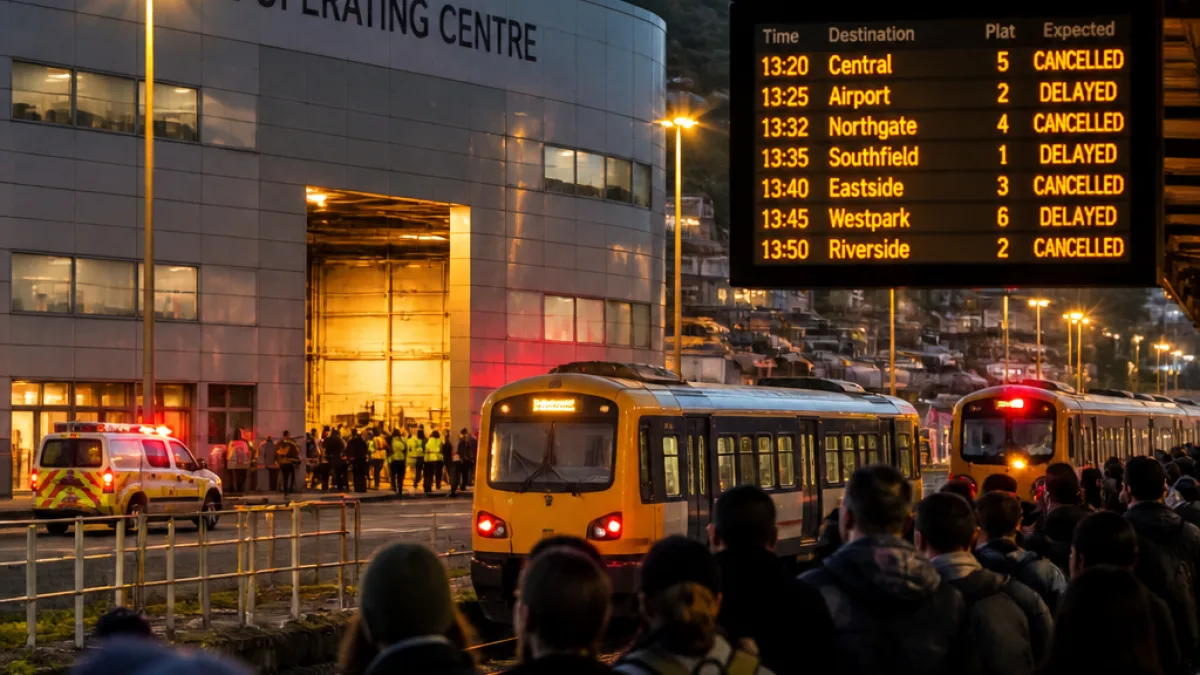
A short power cut at Manchester Rail Operating Centre (ROC) on Thursday caused widespread disruption across the rail network in northern England, with services halted and thousands of passengers affected while operators worked to restore normal timetables.
What happened
Network Rail said the electrical supply was lost for about 90 seconds at roughly 13:40 BST. Although the outage itself was brief, a delayed response by back‑up systems at the Manchester ROC led to a temporary suspension of train movements across the region. Many services were cancelled and others significantly delayed as trains and crew had to be repositioned.
The Manchester ROC, opened in July 2014, centralises signalling and control for a large swathe of the network. Network Rail described the operational boundary of the centre as running from Crewe to Carlisle and from the Welsh border to Todmorden in West Yorkshire.
Impact on passengers and services
Commuters reported overcrowded trains and lengthy diversions. Passengers whose services were cancelled were forced onto alternative trains, some of which lacked air‑conditioning, producing uncomfortable conditions for many.
- Services to and from major hubs such as Liverpool Lime Street and Manchester were affected.
- TransPennine Express continued to experience residual delays while rolling stock and staff returned to their scheduled locations.
- Services travelling north from Birmingham New Street and London Euston were also delayed or cancelled as knock‑on effects spread beyond the North West.
Network Rail’s route director for the North West, Chris Wright, said the organisation was working closely with train operators to restore services as quickly as possible.
"We're continuing to work closely with train operators to return services to normal as quickly as possible," said Chris Wright.
Wider consequences and passenger experience
Passengers described the disruption as chaotic. One traveller said they were packed "like sardines" on a diversionary service to Stockport after their original train to Alderley Edge was cancelled. Others reported anxiously watching timetables, hoping to catch long‑distance connections and making alternative arrangements for events and appointments.
In addition to immediate discomfort, the incident highlighted how even momentary electrical problems can cascade across a modern, centralised rail control system and produce significant operational delays.
Background on the control centre
The Manchester ROC is one of several regional operating centres that centralise signalling functions. The model aims to improve efficiency and safety by consolidating control, but it also concentrates operational risk: when a central node is affected — even briefly — the consequences can be extensive.
| Detail | Information |
|---|---|
| Duration of power loss | Approximately 90 seconds |
| Time of incident | About 13:40 BST |
| Operational boundary (Manchester ROC) | Crewe to Carlisle; Welsh border to Todmorden |
Response and recovery
Network Rail said services had "largely been restored across the North West" by later in the day, but warned that some disruption would continue while crews and trains returned to their usual positions.
Local leaders took an interest in the incident. Newly elected Greater Manchester Mayor Bev Craig said she would be seeking further information from the relevant operators and Network Rail about the cause and the contingency arrangements.
Questions for operators
The episode raises several operational questions for Network Rail and train operators, including:
- Why the back‑up systems did not immediately take over when the supply failed;
- How resilience at centralised control centres can be improved to prevent wide‑scale disruption from short outages;
- What passengers affected should expect in terms of compensation or assistance where journeys were cancelled or significantly delayed.
Network Rail and affected operators will be expected to provide a fuller explanation after investigating the technical cause of the power interruption and why redundancy measures did not operate seamlessly. For passengers, the immediate priority remains the restoration of timetables and clear information about delayed or cancelled services.
Further updates are likely once Network Rail completes its investigation and shares findings with train operators and local authorities.