Mems Ramaila, a lucerne farmer based near Brits in the North West, has transformed a persistent farm nuisance into a growing commercial venture. What began as a question about the bees that swarmed her fields has become Bee African, a woman‑led agribusiness moving from primary honey production into value‑added agro‑processing.
From curiosity to commercial operation
Ramaila says her beekeeping journey started with a chance conversation in 2019 with a German tourist on Vilakazi Street in Soweto. That encounter introduced her to internationally recognised honey judge Arie Krieke, who later spent three weeks on her farm that same year sharing technical expertise in hive management and honey production.
"By then, I had already done extensive research and realised that beekeeping had strong income‑generating potential, while also delivering significant environmental and socio‑economic benefits," Ramaila said.
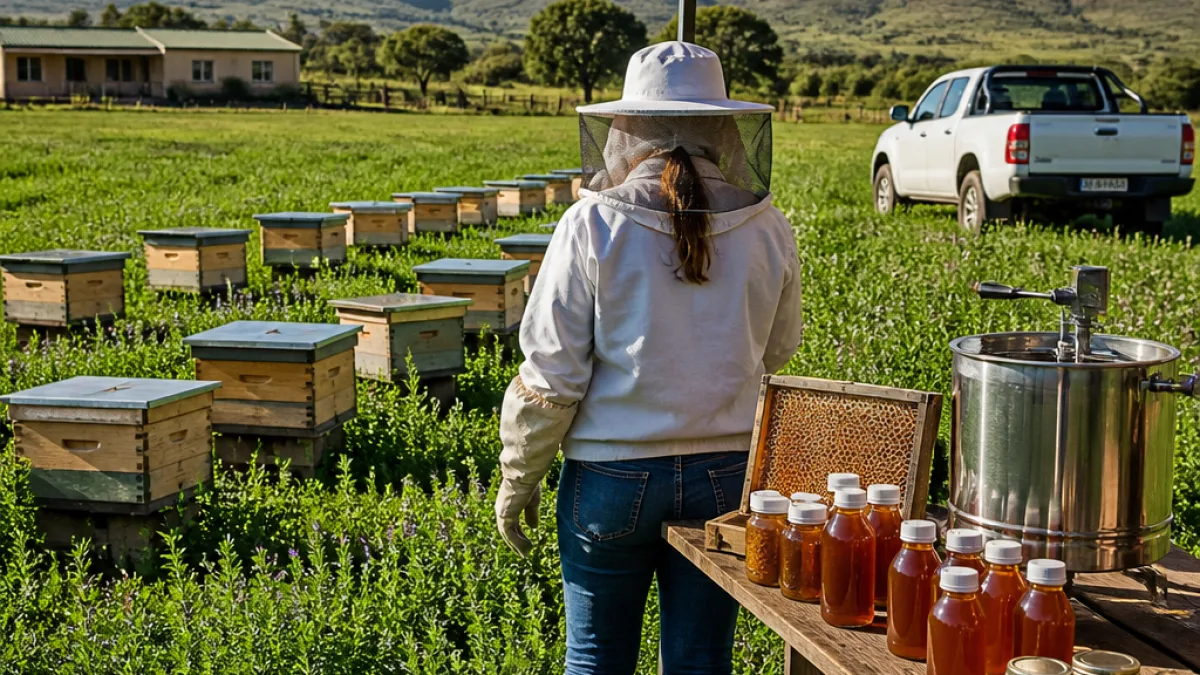
Today, more than 50 beehives are spread across her property. The operation produces honey and is expanding into processing to capture greater value before products reach market.
Growth aided by international partnership
Ramaila’s progress accelerated through participation in the Partnering in Business with Germany Programme, an initiative of the Department of Trade, Industry and Competition (the dtic), the German Federal Ministry for Economic Affairs and Climate Action, and the German Corporation for International Cooperation (GIZ). The programme helps emerging South African exporters access international markets by providing knowledge and networks.
As a further boost, Ramaila attended a three‑week exchange in Germany in 2025 under the dtic–GIZ programme, which she describes as a turning point for Bee African. The visit exposed her to new production methods and market opportunities she is applying back home.
Why this matters for North West farmers
The Bee African story illustrates a few practical benefits for farmers in the province:
- Beekeeping can diversify income streams for crop farmers such as lucerne growers.
- Bees provide pollination services that may boost yields for nearby crops.
- Small‑scale value‑adding (processing and packaging) can raise margins compared with raw commodity sales.
These advantages are particularly relevant in a province where many smallholder and emerging farmers seek complementary enterprises to strengthen resilience against market and climatic variability.
Scaling, challenges and local impact
Ramaila’s move into agro‑processing points to a common path for scaling rural businesses: adding processing capacity to capture more value locally. The article does not supply details on employment numbers or turnover, but the expansion from primary honey production to value‑added products typically requires investment in equipment, packaging and market development.
Participation in export‑oriented programmes such as the dtic–GIZ initiative can help bridge knowledge gaps and open market channels, yet farmers often still face hurdles in certification, standards compliance and logistics when aiming for international markets.
| Year | Event |
|---|---|
| 2019 | Meeting with German tourist; Arie Krieke visits farm for three weeks |
| 2025 | Three‑week exchange in Germany via dtic–GIZ programme |
| Present | Bee African operates 50+ beehives and produces value‑added honey products |
For other farmers interested in beekeeping, Ramaila’s experience highlights practical steps: conduct research, seek mentorship or technical assistance from experienced apiarists, and explore support programmes that link producers to markets. Programmes such as the dtic–GIZ Partnering in Business with Germany can be an avenue for training and market access.
As Bee African grows, it also contributes to changing gender dynamics in a largely male‑dominated beekeeping sector. The prominence of a woman‑led enterprise in the North West may encourage more women farmers to consider apiculture as a viable enterprise.
While the account focuses on Ramaila’s progress, it points to wider themes for provincial agriculture: diversification, skills transfer through international cooperation, and the importance of value‑addition for rural economic development.