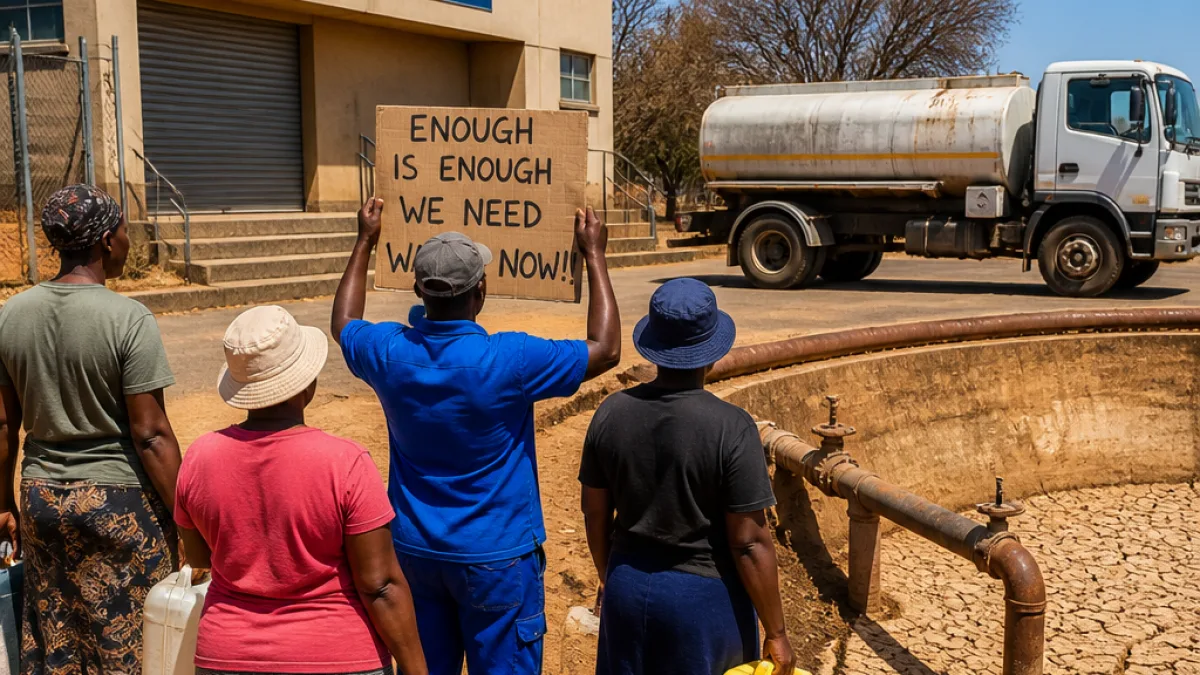
Free State communities are contending with a sustained water service emergency, with some areas reportedly without a dependable supply for years while provincial systems show a high proportion of risk, the Democratic Alliance (DA) said.
Long-running shortages and local breakdowns
David McKay, the DA’s CoGTA spokesperson in the Free State Legislature, told the party had lodged questions with the Free State Department of Cooperative Governance, Traditional Affairs and Human Settlements (CoGTA) and would approach the National Council of Provinces (NCOP) over what he described as ongoing municipal failures.
“We will launch oversight visits and submit formal complaints to the Department of Water and Sanitation regarding ongoing failures in municipalities,”
McKay highlighted particularly grave situations in several municipalities. He said areas in the Matjhabeng municipality have lacked a reliable water supply for 18 years. Residents of Winburg in the Masilonyana municipality were reported to be enduring a complete blackout in water supplies for eight weeks. Letsemeng and Metsimaholo were described as suffering persistent water shedding and frequent interruptions.
Provincial risk and monitoring failures
McKay referenced national commitments to tackle water infrastructure, including President Cyril Ramaphosa’s announcement of a R156 billion investment to address South Africa’s water crisis and the establishment of a National Water Crisis Committee. He said those national initiatives had not yet translated into proactive improvements for the Free State.
The DA spokesperson pointed to the latest Blue Drop Progress Report, which, he said, confirmed the Free State had the second-highest proportion of high- and critical-risk water systems in the country. He added that nearly half of the province’s water treatment works failed to submit basic flow-monitoring data, a sign of a breakdown in operational management.
Technical and public health concerns
According to the DA’s assessment, technical skills and maintenance capacity in municipalities are inadequate and Water Safety Plans are largely not implemented. The party warned that the lack of reliable water undermines sanitation and could increase the risk of disease outbreaks, constituting a major public health emergency.
- Matjhabeng: some areas without reliable water for 18 years
- Masilonyana (Winburg): complete water blackout for eight weeks
- Letsemeng and Metsimaholo: ongoing shedding and interruptions
- Provincial systems: high share of high‑ and critical‑risk systems; poor flow‑monitoring compliance
What the DA plans next
McKay said the DA will undertake oversight visits and submit formal complaints to the national Department of Water and Sanitation. Those actions aim to press for remediation and to compel both provincial and national structures to account for service delivery failures.
| Issue | Location | Duration / Status |
|---|---|---|
| Unreliable supply | Matjhabeng | Reportedly 18 years |
| Complete blackout | Winburg (Masilonyana) | Eight weeks |
| Water shedding and interruptions | Letsemeng, Metsimaholo | Ongoing |
Context and implications
South Africa has seen increasing emphasis at national level on water infrastructure investment and crisis management. The DA’s allegations place the spotlight on whether those national measures are reaching or benefiting the Free State’s municipal systems, where operational weaknesses and monitoring lapses are said to be widespread.
Beyond immediate access to drinking water, sustained interruptions have knock-on effects for sanitation, health, agriculture and local economies. The absence of reliable flow data from treatment works complicates efforts to assess water quality and to plan repairs or upgrades.
The DA’s planned oversight visits and formal complaints will put municipal managers and the provincial department under scrutiny. The party has asked the NCOP and the national Department of Water and Sanitation to respond to the scale of the failures and to provide a timeline for interventions funded through national investment plans.
Neither responses from the Free State CoGTA nor from the Department of Water and Sanitation were included in the information reported by the DA. Local residents, community organisations and municipal officials were not quoted in the party’s briefing.
This developing situation will affect household routines and public services while authorities consider remedial steps. Residents dependent on municipal supplies will need to continue making contingency arrangements until reliable services are restored.