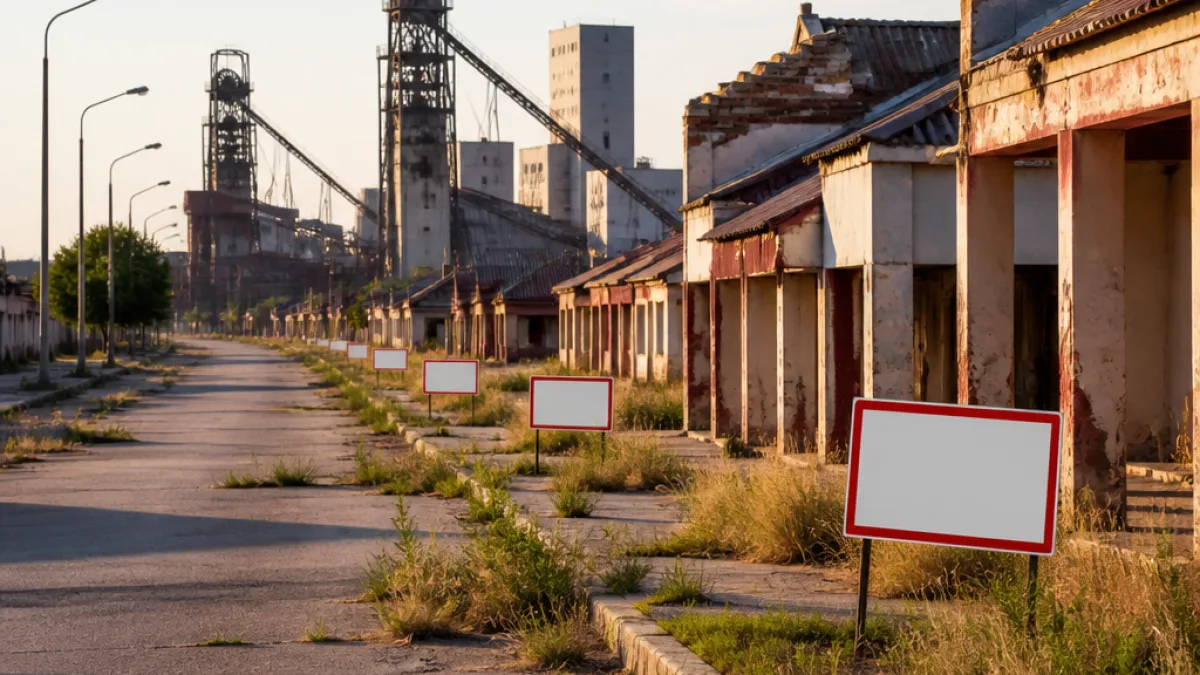
The collapse of large-scale gold mining in the central Free State drove a profound economic contraction that cost an estimated 150,000 jobs and reduced the population of Welkom and its surrounds from about 180,000 to roughly 36,000, according to a study cited by the Stockholm Environment Institute.
How a single-industry town unravelled
For decades Welkom grew as a purpose-built mining town, its fortunes tied to deep-level gold extraction that accelerated after the Second World War. Mining created thousands of direct jobs and a wider ecosystem of businesses supplying and servicing the industry. Over time, however, the area's economic dependence on one sector meant it had limited resilience to industry-wide shocks.
Researchers Claudia Strambo and Aaron Atteridge identify a so-called "perfect storm" of factors that undermined the mining business model in the Free State: increased state intervention through new legislation, rising electricity costs, faltering infrastructure and a sustained fall in gold prices. The combination, they say, raised regulatory and operating costs to the point where many operations became uneconomic.
Consolidation of early mining interests into large companies such as the precursor to AngloGold Ashanti supported the region’s boom for decades. The company now sits as one of the largest names in global gold mining and is quoted in the study with a group valuation of around R656 billion. But the study highlights that corporate value at the top of the sector did not protect the region from widespread job losses when smaller, higher-cost operations closed.
Local and social fallout
The human cost of the industrial decline is visible in demographic change and in the erosion of the local economy. Towns built to house mineworkers and their families lost population rapidly as employment opportunities disappeared. Services that relied on mining wages contracted or closed, and informal economic activity increased in response to fewer formal jobs.
While the study frames the Free State goldfields as an example of an unplanned industrial transition, its findings have contemporary resonance. South Africa is undertaking a Just Energy Transition to move away from coal-fired electricity towards renewable sources. The researchers warn that transitions which are not carefully planned and supported can generate substantial social dislocation—echoing the experience of mining communities in the Free State.
Policy questions and lessons
The collapse in the Free State raises several policy questions for national and provincial government as they design transitions in energy and other carbon-intensive sectors:
- How will workers and communities dependent on single industries be supported during structural change?
- What role should state agencies play in managing costs such as electricity that directly affect industrial viability?
- Can economic diversification be promoted early enough to give towns alternatives to a single dominant employer?
Researchers explicitly link the Free State experience to the risks of leaving transitions unplanned. The study shows how policy, market and infrastructure failures can combine to render long-standing local economies non-viable, with consequences that persist for decades.
Numbers at a glance
| Measure | Reported figure |
|---|---|
| Estimated job losses | 150,000 |
| Population – Welkom and surrounds (before) | ~180,000 |
| Population – Welkom and surrounds (after) | ~36,000 |
| AngloGold/related corporate valuation (as cited) | R656 billion |
The figures used in the study underline the scale of the economic reversal. They also point to the uneven distribution of benefits and vulnerabilities within extractive industries: while corporate valuations can remain high, employment and local incomes can collapse when marginal operations are pushed out by higher costs.
What this means for the Free State now
For the Free State provincial government and local municipalities, the case of the goldfields is a cautionary tale. Diversification, investment in local infrastructure and the timing and sequencing of regulatory change are likely to be central to any plan that seeks to avoid repeating the same outcomes in other sectors.
As South Africa navigates energy and industrial transitions, the experience of the Free State goldfields provides a concrete reminder: transitions that do not include social and economic planning risk leaving entire communities behind.