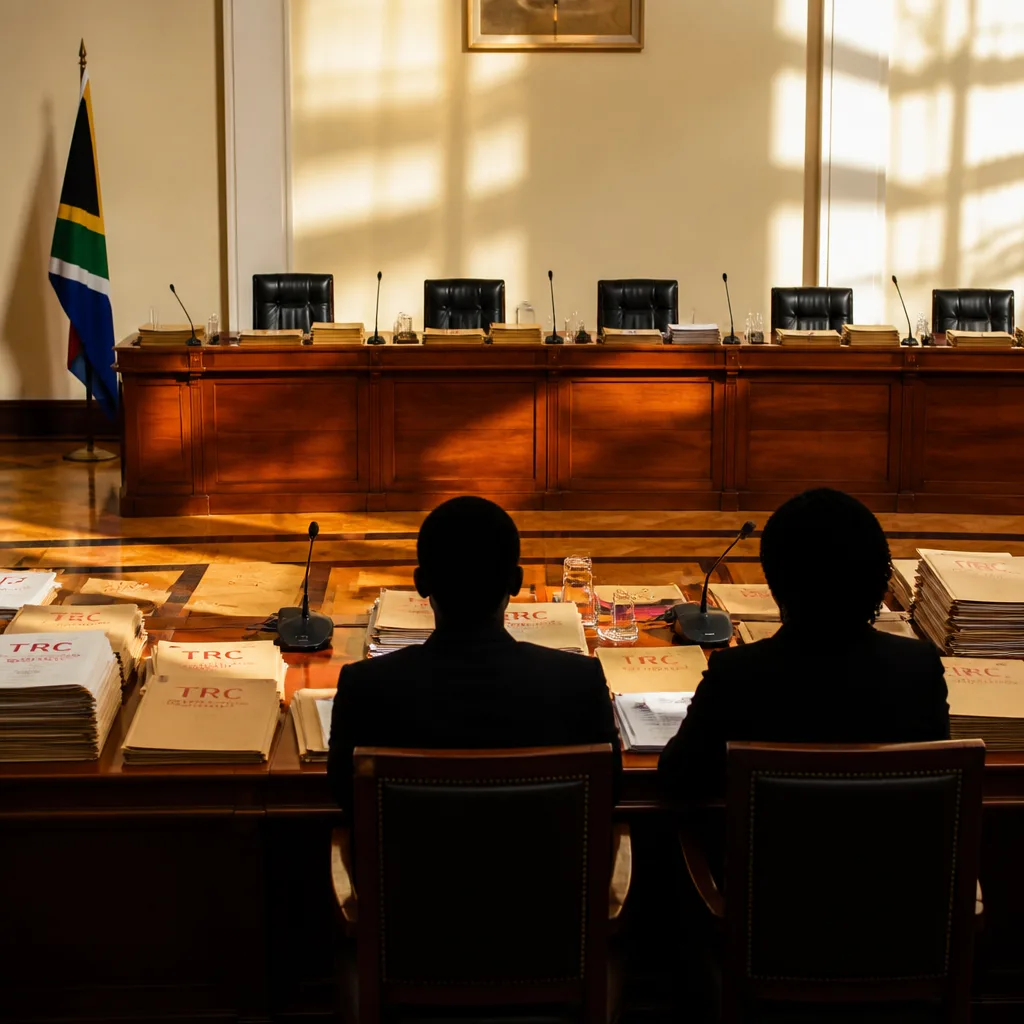
The Truth and Reconciliation Commission (TRC) Cases Inquiry heard on Thursday that a combination of political reluctance, institutional friction and poor resourcing has obstructed transparent and effective follow-up to the original TRC work.
Inadequate political commitment and coordination
Piers Pigou, a TRC specialist who served in the commission's Investigation Unit, told the inquiry chaired by Justice Sisi Khampepe that progress on TRC cases had been limited by a lack of political will and by finger-pointing between the National Prosecuting Authority (NPA) and the South African Police Service (SAPS). He said there was insufficient unified political commitment across government to prioritise examination and prosecution of past crimes.
"There has been significant criticism directed at security forces, the ANC, and Parliament, but in my view, there was insufficient political interest in examining and prosecuting past crimes,"
Pigou also criticised the absence of coordination between departments, which he said produced rushed and poorly organised statement-taking. That, he told the inquiry, made subsequent prosecutions difficult.
Resource constraints and poor statement-taking
Central to Pigou's evidence was the claim that resources were not adequately allocated to investigative work. He said limitations and constraints affected how investigators collected witness accounts, with a problematic shift from detailed individual statements to broader community-based statements.
- Poor statement-taking: Rushed and consolidated statements hindered case-building.
- Resource allocation: Investigations were constrained by insufficient investment in the statement-gathering process.
- Institutional friction: Lack of coordination between SAPS, the NPA and other departments impeded progress.
According to Pigou, the compounding effect of these factors was that many TRC matters were not prosecuted effectively, despite public expectations created by the commission’s original work.
Transparency concerns over the TRC's report
Pigou expressed dismay that the TRC report itself was not made readily accessible to the South African public. He noted that while the commission's proceedings had been broadcast on radio and television, the substantive report was not circulated, and was effectively removed from public view after parliamentary debate and subsequent departmental action.
"There was never a report that was made publicly available to South Africans. It was a bit astonishing. Once we had the debate in Parliament, then this sub-committee had been set up in the Department of Justice. It was packed away out of the public domain. It was a tick, done, move on,"
That lack of public availability, Pigou said, contributed to a disconnect between the TRC's public profile and follow-through on its recommendations.
Implications for justice and reconciliation
The inquiry’s testimony underscores a long-standing tension in South Africa’s transitional justice framework: the difference between a process that documents abuses and one that ensures accountability. Pigou’s evidence suggests that without sustained political backing, adequate resources and coherent institutional cooperation, the prosecutorial follow-up necessary to translate truth-telling into legal consequences remains fragile.
For victims and families seeking closure, the gaps identified by Pigou point to structural barriers to accountability. For policymakers, they present a checklist of practical reforms: clear interdepartmental coordination mechanisms, ring-fenced resources for investigative work, and active measures to make TRC findings available and actionable.
| Problem identified | Effect on TRC cases |
|---|---|
| Lack of political will | Low prioritisation of prosecutions and investigative follow-up |
| Poor coordination (NPA, SAPS, departments) | Rushed statements; weakened evidentiary basis for cases |
| Insufficient resourcing | Inadequate investment in statement-taking and case preparation |
| Limited public access to the TRC report | Reduced public scrutiny and political pressure for follow-up |
The inquiry, chaired by Justice Khampepe, is examining why so many TRC-related matters did not translate into prosecutions or other legal remedies. Pigou’s testimony adds to a body of evidence arguing that failure to prioritise the post-TRC investigative phase has consequences for the credibility of transitional justice in South Africa.
How Parliament, the Department of Justice, the NPA and SAPS respond to these findings will determine whether the legacy of the TRC remains primarily historical testimony, or can be turned into a lasting framework for accountability and reconciliation.