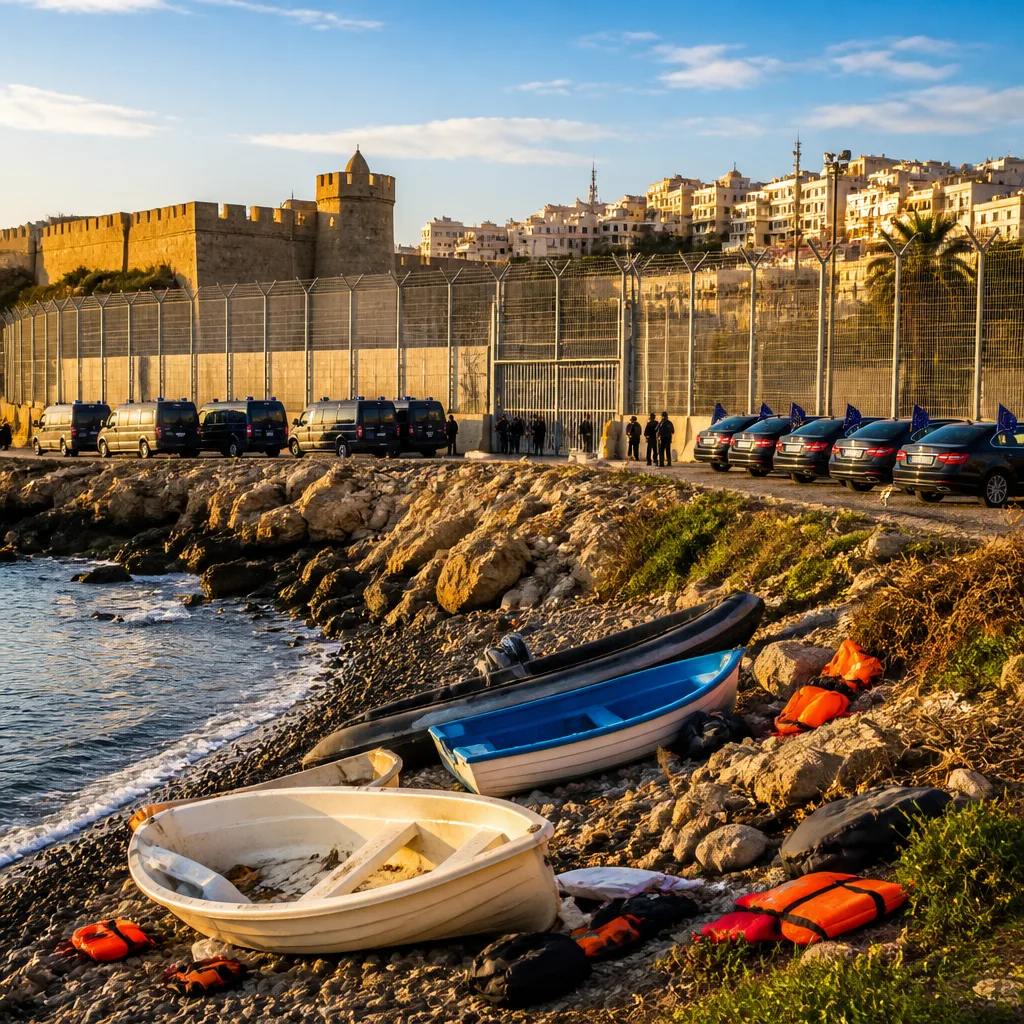
Last week’s deadly scenes in the Spanish exclave of Ceuta, where at least 88 people died while attempting to reach European territory, prompted a rapid political backlash across the European Union that analysts say was rife with misdiagnosis and theatre.
Political manoeuvring amid a humanitarian shock
Italy, Denmark and Finland were among capitals that proposed punitive measures after the mass crossings, with Italy temporarily reintroducing border controls for travellers from Spain and declaring a one‑month “suspension” of the Schengen free‑movement area, Euractiv reported. An open letter signed by 22 EU leaders — led by Italy’s Giorgia Meloni and Denmark’s Mette Frederiksen — warned of their “readiness to take any necessary measures” to block onward migration, the report said.
“readiness to take any necessary measures”
But the idea of suspending Schengen in response to the Ceuta episode exposed a basic misunderstanding: Ceuta is effectively outside Schengen customs and border-free arrangements. Passport and visa checks are already carried out for all departures from the territory, Euractiv noted, making calls for Schengen’s suspension analogous to advocating an irrelevant policy fix.
Scale, geography and immediate returns
Ceuta’s small physical size — just under twenty square kilometres — and the enclave’s border with Morocco mean that the dynamics there differ sharply from large continental crossings. Euractiv pointed out that the majority of the roughly 80,000 people who entered the territory during the incident were likely to be returned to Morocco; within 48 hours most had been sent back, the analysis said.
The rapid expulsions and Ceuta’s geography undercut the premise that new EU border measures on the mainland would meaningfully block flows that are already constrained by existing checks and bilateral arrangements with Morocco.
What drove the crisis — and what leaders ignored
Euractiv underscored that political opportunism played a clear role in the stern reactions. The incident offered a platform for leaders critical of migration to attack Spain’s more permissive stance under Prime Minister Pedro Sánchez. Yet the European letter omitted any reference to the underlying socioeconomic drivers that reporting from The New York Times, Reuters and others attributed to the surge: deep economic hardship among young people in Morocco, including very high rates of unemployment among 15‑ to 24‑year‑olds, the analysis said.
In other words, the EU debate focused on restricting movement rather than addressing the conditions that push people to risk perilous journeys in the first place. That omission, Euractiv argued, reflects a broader gap between political rhetoric and the structural realities shaping migration.
Short‑term optics versus longer‑term policy
The episode highlights two competing logics in migration policy: short‑term border management and longer‑term strategies tackling root causes. The immediate responses by some EU leaders prioritised visible action to reassure domestic electorates, even where the proposed measures had limited practical effect given existing controls and agreements.
- Misreadings of Schengen: Calls to suspend or expel Spain overlooked that Ceuta was already subject to passport and visa controls.
- Political signalling: The crisis offered a platform for leaders seeking to demonstrate toughness on migration.
- Root causes ignored: Coverage and statements largely failed to address the economic desperation in Morocco highlighted by international reporting.
For South Africa and other countries grappling with migration policy, the Ceuta episode is a reminder that high‑profile border incidents often generate politics that are more about domestic narratives than effective regional governance. Policy responses that ignore context — geography, existing legal regimes and the socioeconomic drivers of movement — risk producing symbolic measures rather than durable solutions.
| Element | Reported detail |
|---|---|
| Reported deaths | 88 |
| People who entered Ceuta | About 80,000 |
| Territory size | Just under 20 km² |
Where the EU moves from crisis reaction to strategy will determine whether this episode drives more effective cooperation with neighbouring countries or merely entrenches polarised domestic politics. Euractiv’s assessment suggests the former will require confronting uncomfortable questions about labour markets, youth economic opportunity and bilateral migration management — not only invoking Schengen or frontier controls for political effect.