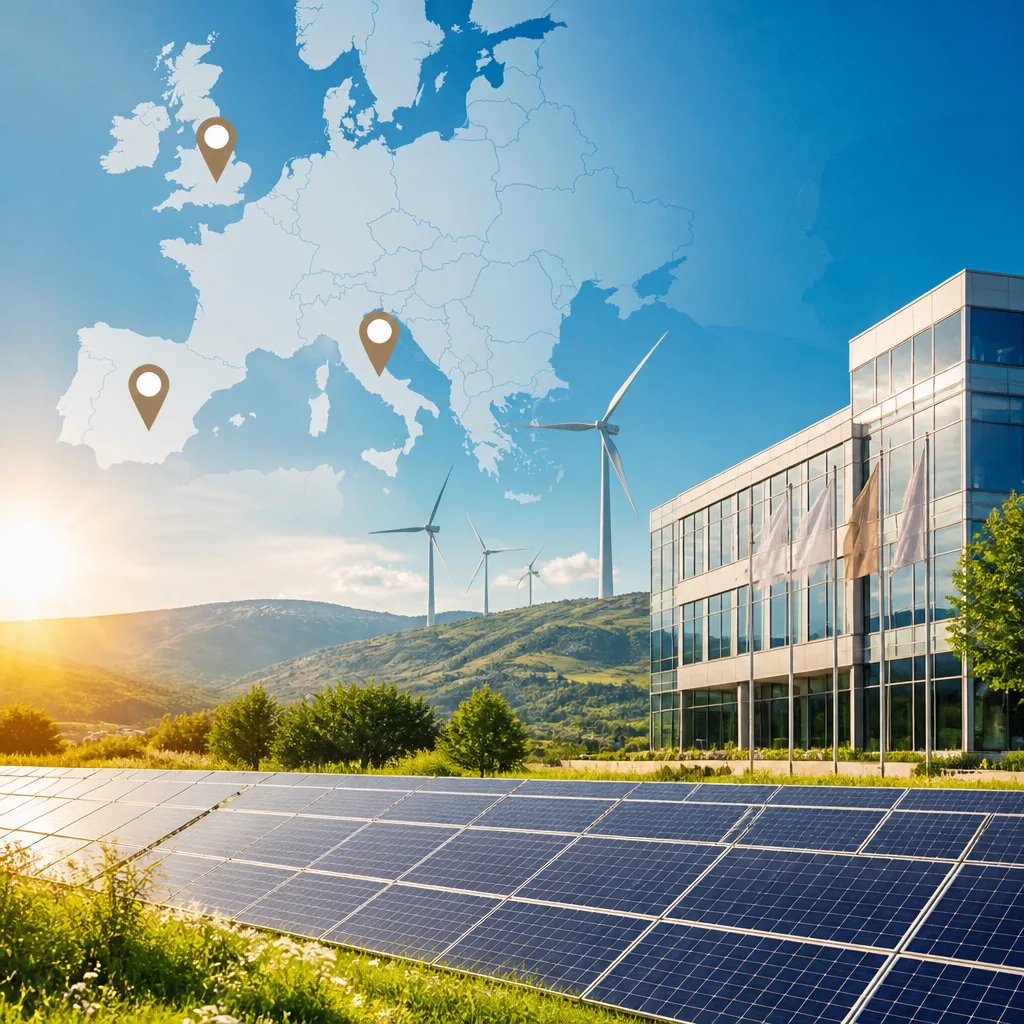
TotalEnergies has agreed to acquire Shell’s entire European onshore renewables business, a transaction that transfers about 500 MW of operating capacity and a development pipeline of roughly 3.5 GW of solar, wind and battery projects across Italy, the United Kingdom and Spain.
What the deal includes
The companies said the purchase gives TotalEnergies immediate additional generation and a multi‑gigawatt line of projects at various stages of development. The assets are concentrated in three European markets that remain central to the continent’s transition to low‑carbon power.
| Item | Figure |
|---|---|
| Operating onshore capacity transferred | 500 MW |
| Development pipeline (solar, wind, storage) | 3.5 GW |
Context: a split in strategy among energy majors
Analysts say the transaction underlines a widening gap in how global oil and gas companies approach the energy transition. Shell’s decision to divest its European onshore renewables holdings fits a pattern of retreat from owning generation assets, enabling it to concentrate on its core oil and gas activities and other parts of its portfolio. TotalEnergies, by contrast, is expanding its owned renewables footprint, consolidating operating projects and a pipeline that can be brought to market under its balance sheet and brand.
Separately, TotalEnergies announced a deal with private equity firm KKR under which KKR will buy a 50% stake in about 1.2 GW of onshore solar and wind facilities spanning Germany, Spain, France and Poland. Together, these moves show renewables ownership being split between industrial utilities and institutional investors.
Why this matters for markets and investors
There are three immediate implications:
- Asset ownership models are shifting — industrial groups are consolidating some portfolios while private capital takes minority stakes, creating hybrid ownership structures that can accelerate project delivery.
- Companies that scale through acquisitions may capture development pipelines and operating experience more quickly than those choosing to partner or exit ownership entirely.
- For governments and regulators, the buyer profile matters: utilities and integrated energy firms often have different approaches to grid contracts, power purchase agreements (PPAs) and local content requirements than financial investors.
For corporate buyers and large consumers in South Africa and the region seeking long‑term PPAs, the deal signals where counterparties might come from. A larger industrial player such as TotalEnergies tends to underwrite projects and engage in direct offtake arrangements, while private equity partners may seek shorter horizon returns or sell stakes into secondary markets.
What it does not change — yet
Neither announcement alters the underlying market dynamics that drive renewables deployment: declining technology costs, permitting and grid access issues, and national regulatory frameworks. The transaction is a re‑allocation of assets and risk among corporate players rather than a new source of generation in the short term.
However, the prominence of private capital in recent deals — exemplified by KKR’s co‑investment — suggests more capital will be available for development if projects clear regulatory and grid hurdles. That could speed delivery in markets where policy and transmission capacity allow rapid build‑out.
Takeaway for South African readers
While the assets in the deal sit in Europe, the strategic choices of large energy companies affect global capital flows. South Africa’s renewables sector, which competes for institutional investor attention, will feel the knock‑on effects in terms of available financing structures and the appetite of corporate offtakers for long‑dated power contracts.
The deal is another reminder to policymakers and utilities that attracting long‑term private capital requires predictable procurement processes, clear grid expansion plans and stable contract frameworks that align investor return expectations with national energy goals.
Key consequences: a reorganisation of who owns renewable projects, faster consolidation by some utilities, and growing participation by private equity in the clean‑power value chain.