New experimental work from researchers at the Institute For Basic Science in South Korea suggests the brain's primary visual cortex performs more complex computations than previously thought, extracting compact statistical summaries from visually chaotic scenes. The findings indicate that the process known as ensemble perception—pooling many elements into a single summary—begins earlier in the visual pathway than models that place this work in higher cortical areas.
How the experiment worked
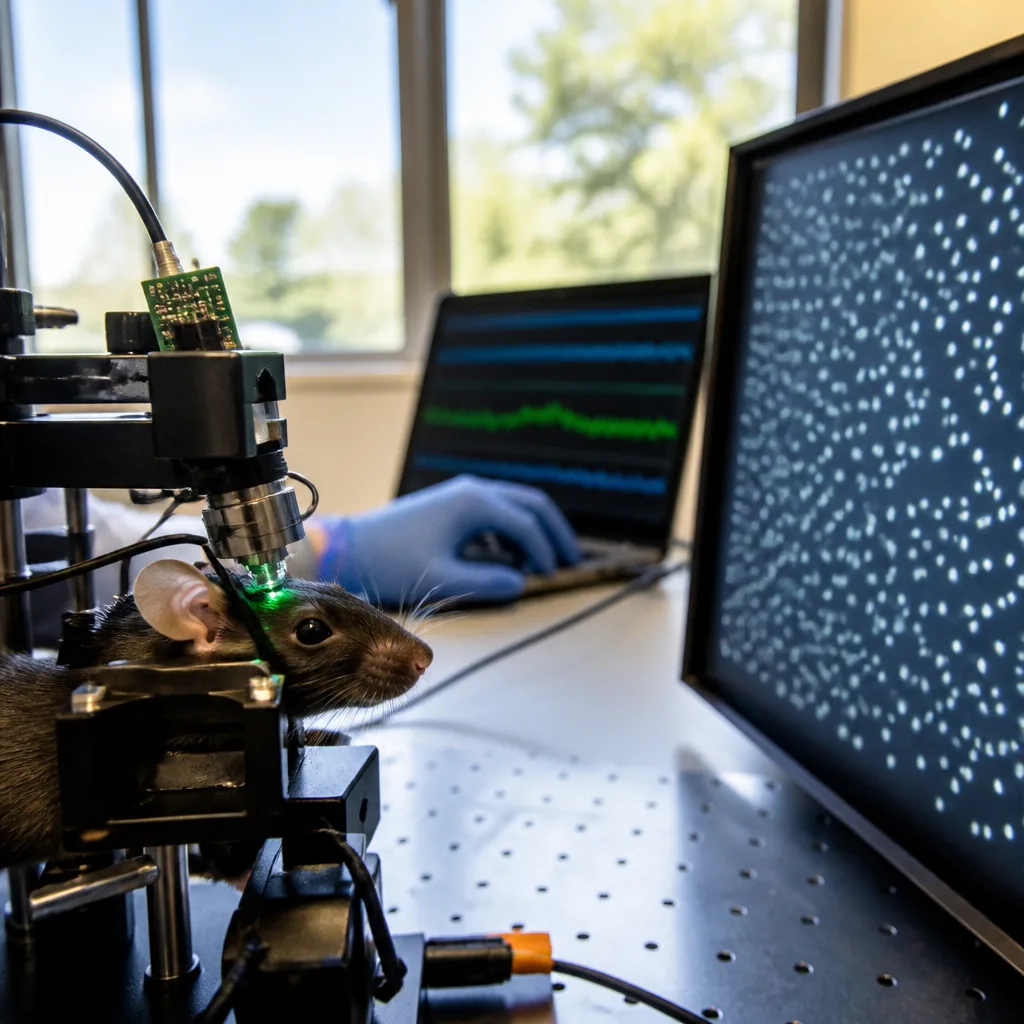
To probe how the brain computes a scene-level summary, the team trained head-fixed mice to report the overall direction of motion on a screen. Stimuli consisted of hundreds of randomly moving dots, with every dot moving in its own direction across a range. Because the average motion existed only as a mathematical summary of all elements, mice could not succeed by tracking a single dot; instead the task required pooling information across many elements to judge whether the overall motion was leftward or rightward.
- The mice performed accurately even with stimuli so noisy that humans would struggle to identify the average direction.
- Neural activity was recorded in visual brain regions using miniature calcium-imaging microscopes to link behaviour to circuit computations.
"This early statistical compression is what allows us to walk into a crowded room, glance at a busy highway, or watch a flock of birds and instantly ‘get’ what is happening without being overwhelmed by the details," said Young-Beom Lee, a professor at the Institute For Basic Science’s Center For Memory and Glioscience, according to the reporting.
Findings and interpretation
The study reports that neuronal signals in the primary visual cortex reflect a compressed representation of the scene—one that captures meaningful statistical patterns rather than merely relaying raw sensory input. The authors argue this early compression explains how animals and humans can rapidly form useful impressions of cluttered, dynamic environments without processing an overwhelming amount of detail.
Co-lead author Yee-Joon Kim described the research goal as understanding how the brain discards irrelevant detail while preserving the most useful structure of a scene. The experiment’s design forced animals to compute an average motion direction across many elements, enabling the team to identify neural signatures of ensemble perception in early visual circuits.
| Element | Detail |
|---|---|
| Subjects | Mice (head-fixed) |
| Stimulus | Hundreds of randomly moving dots, average direction only present as a statistical summary |
| Task | Categorise overall motion as left or right by turning a wheel |
| Recording method | Miniature calcium-imaging microscopes |
| Key result | Primary visual cortex signals encode compressed, scene-level statistical structure |
Context and consequences
The finding repositions the primary visual cortex from a predominantly feed‑forward relay toward an active processor that extracts statistical regularities. That has several implications.
- For neuroscience, it suggests models of perception must account for statistical computation at earlier stages of processing.
- For artificial intelligence, understanding biological strategies for rapid scene summarisation could inspire more efficient algorithms for vision in cluttered environments.
- For clinical science, earlier computations of ensemble features may be relevant to disorders where perception of global structure is affected, although the study itself does not test clinical populations.
The researchers used mice and focused on motion-based ensemble perception. While mice share many basic visual circuit motifs with primates, translation to human vision will require further comparative work. The study does not claim that all forms of ensemble perception are computed in the same cortical stage or that higher areas are unimportant; rather, it provides evidence that primary visual cortex contributes significantly to forming compressed representations of complex scenes.
By showing that useful summaries can be extracted early, the work helps explain everyday feats—such as navigating a busy street—where the brain must rapidly reduce sensory complexity while preserving behaviourally relevant information.