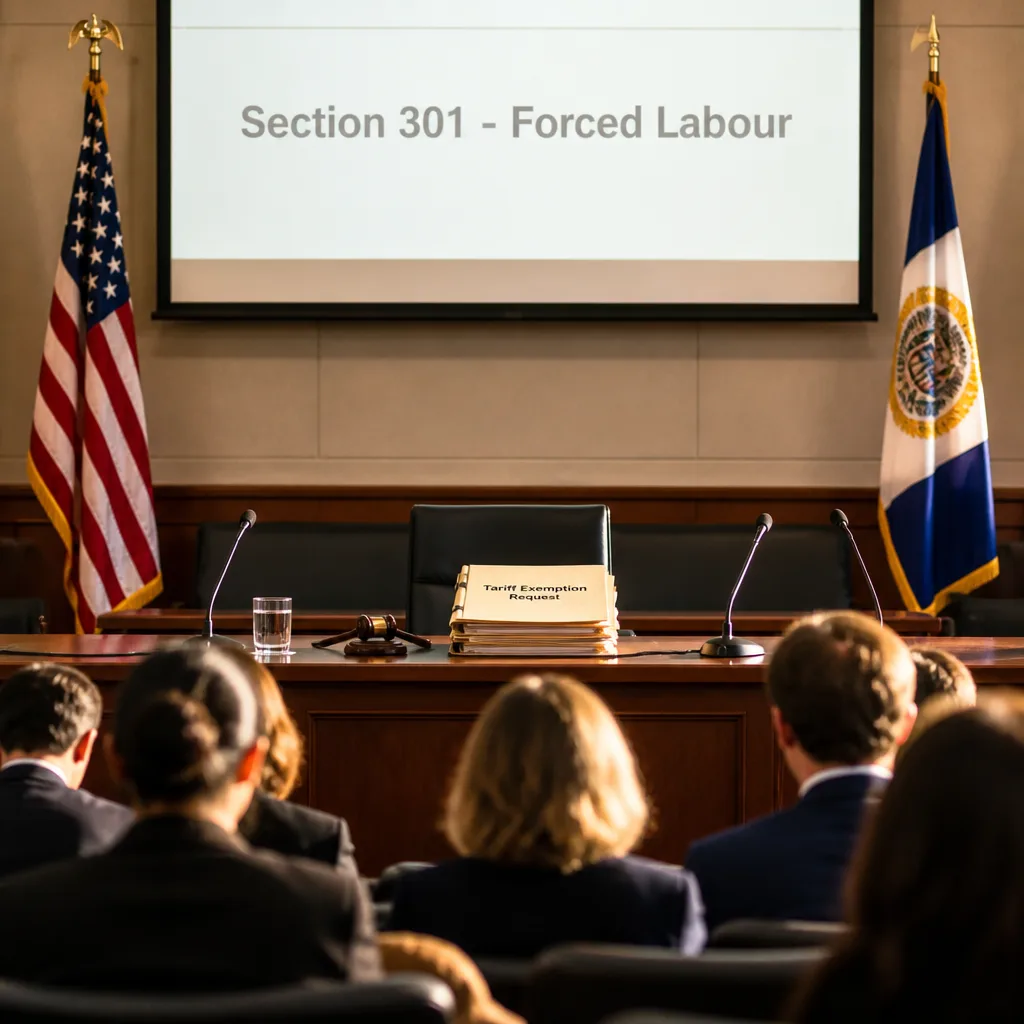
South Africa has sought an exemption from a 12.5% tariff the United States imposed following an investigation under Section 301 of the US Trade Act of 1974 into goods produced using forced labour, the Department of Trade, Industry and Competition (DTIC) said.
US probe under Section 301
The inquiry by the United States Trade Representative (USTR) examined whether countries, including South Africa, effectively prohibit the production and trade of goods made with forced labour. Washington applied a 12.5% tariff on all goods from South Africa after the country was found to fall foul of the probe, according to government statements reported in the source material.
The US action aims to stop imports produced with forced labour from undercutting US producers. The USTR framed the investigation as part of a broader concern that “governments have failed to effectively enforce measures banning goods produced with forced labour from entering their markets.”
“Despite the international consensus against forced labour, governments have failed to effectively enforce measures banning goods produced with forced labour from entering their markets,” USTR Jamieson Greer said.
South Africa’s response and engagement
Following the imposition of tariffs, South Africa dispatched a delegation to Washington to request an exemption. The DTIC participated in a public hearing in July, where it argued that the country has legislation that prohibits forced labour and a legal framework that can be used to prevent the importation of goods produced with forced labour into South Africa.
“South Africa maintained that it has enabling legislation that contains provisions that can be invoked to deal with forced labour,” the government said in its submission, and requested that the United States consider exempting the country from the tariff.
What the investigation covers
The US review looked not only at whether South Africa produces goods with forced labour but also at whether countries allow such goods into their own markets. The stated aim is to prevent cheaper, forced‑labour‑produced exports from gaining an unfair advantage over legitimately produced American goods.
- Measure invoked: Section 301 of the US Trade Act of 1974.
- Action taken: 12.5% tariff on all goods from South Africa.
- South Africa's position: DTIC told the US hearing it has laws and frameworks to deal with forced labour and requested an exemption.
| Item | Detail |
|---|---|
| US legal basis | Section 301, Trade Act of 1974 |
| Tariff imposed | 12.5% on goods from South Africa |
| South Africa's action | Delegation to Washington; DTIC participated in July public hearing requesting exemption |
Implications and next steps
The source material records the formal request for exemption and the DTIC’s testimony at the public hearing. It does not set out the US response to that request or timelines for any decision. The US move follows broader concerns in Washington about forced labour and the integrity of supply chains entering the US market.
South Africa’s appeal emphasised the existence of enabling legislation and mechanisms to tackle forced labour domestically. The government’s engagement in Washington is intended to persuade US authorities that South Africa is able to prevent the entry into its market — and, by extension, the supply chain — of goods produced with forced labour.
This remains an evolving trade and diplomatic matter between South Africa and a major trading partner. The tariff, while imposed at a flat rate across South African goods, was applied following a finding under a US statutory investigation; any change to that measure will depend on further US administrative or political processes, which have not been detailed in the available reporting.