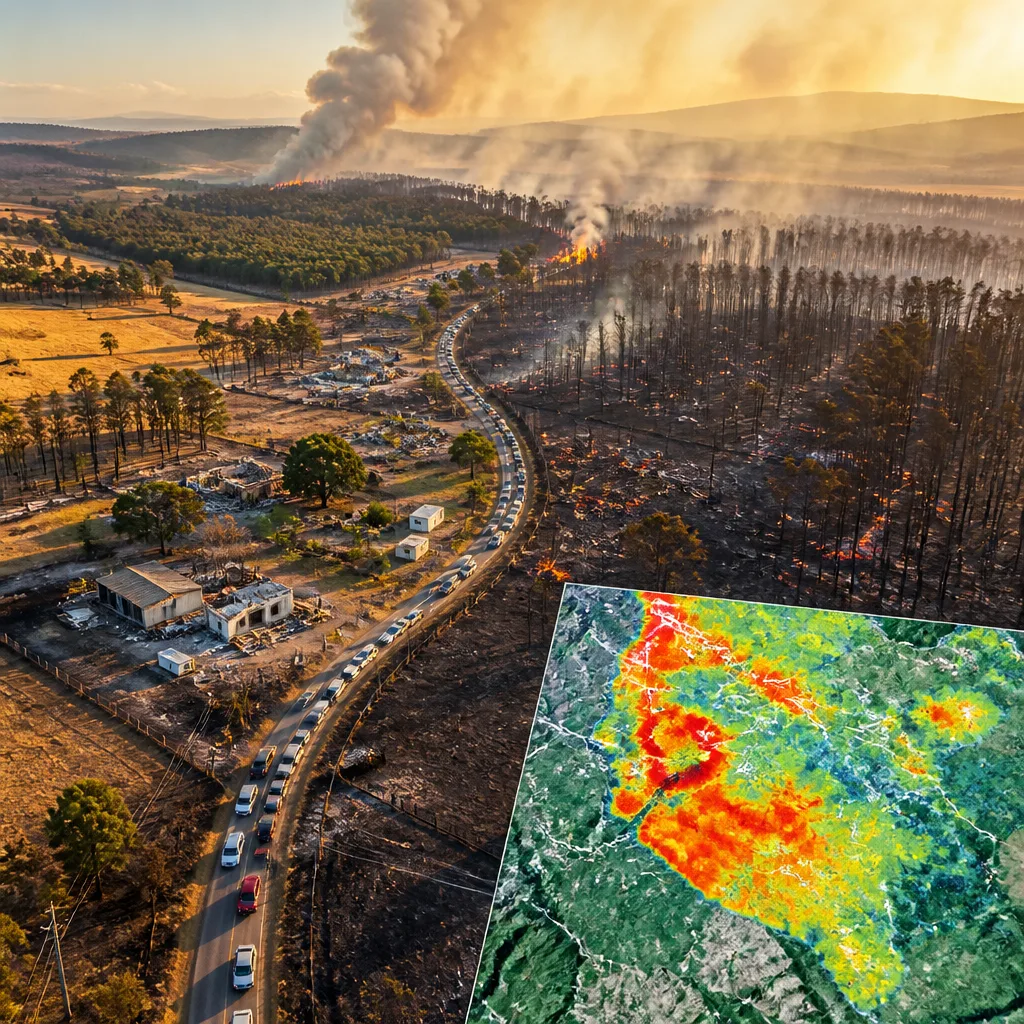
Raging wildfires in Spain and France in July 2026 charred vast tracts of land, forced mass evacuations and destroyed homes and infrastructure as extreme heat and prolonged drought primed landscapes for rapid fire spread, according to satellite observations and analyses.
"Raging wildfires disrupted summer in Spain and France amid sweltering heat waves and prolonged drought."
Scale and immediate impacts
NASA imagery and related analyses show some of the most consequential fires ignited in mid‑July in Spain's central provinces and in southwestern France. Authorities in Spain reported an inferno in Ávila that initially charred about 50,000 hectares before merging with nearby blazes; by 24 July the combined area affected around Burgohondo had grown to about 77,000 hectares. In France, one of the largest fires in recent years burned more than 42,000 hectares west of Bordeaux, devastating communities such as Le Porge.
By late July, the European Forest Fire Information System registered more than 90,000 hectares burned across France—more than in any recent season, the NASA report said. Satellite data from Landsat 9 and other platforms captured extensive brown, charred areas where healthy vegetation had shown as light green before the fires.
Human and infrastructure consequences
News reports and satellite imagery indicate flames affected homes, restaurants, campgrounds, marinas and other infrastructure, and authorities ordered large‑scale evacuations. The fires drove hundreds of thousands of people from their homes in the affected regions and destroyed substantial built assets around reservoirs and leisure areas.
- Large evacuations were necessary in both Spain and France as fires advanced into inhabited areas.
- Residential and recreational infrastructure surrounding reservoirs and coastal villages suffered severe damage.
- Transport and local services were disrupted in affected departments and provinces.
Conditions that worsened fires
Analyses cited by the NASA report tied the scale of these blazes to environmental conditions that developed over preceding months. Researchers with The State of Wildfires Project found unusually wet winter weather followed by a prolonged drying period and intense heat waves—conditions that left large areas of vegetation dry and highly flammable by July.
Such sequences—above‑average moisture that encourages vegetation growth, succeeded by heat and drought—create abundant fuel loads that enable fires to grow quickly and join into larger complexes when ignitions occur.
| Location | Reported area burned (hectares) |
|---|---|
| Ávila region, Spain (initial) | ~50,000 ha |
| Burgohondo and merged fires, Spain | ~77,000 ha |
| Gironde department, France (large fire) | >42,000 ha |
| France (total, late July) | >90,000 ha |
Wider context and implications
Although wildfires are a seasonal phenomenon in Europe, the report emphasises that the July 2026 events were among the most disruptive in decades for Spain and France. The combination of exceptional heat, extended drought and antecedent wet periods that increased fuel loads is a pattern climate scientists warn will become more common as heat waves intensify in many regions.
For policymakers and emergency services the fires underline persistent challenges: improving early detection, ensuring rapid aerial and ground response capacity, reducing fuel in vulnerable landscapes, and protecting communities and infrastructure. The damage to homes, tourism facilities and water‑adjacent assets such as marinas also points to socioeconomic costs that will require recovery planning.
Satellite monitoring—illustrated by the Landsat 9 imagery cited in the report—played a central role in mapping burn scars and assessing impacts quickly across large and often inaccessible areas. Such remote sensing is increasingly important for real‑time situational awareness and for compiling data needed to understand trends in fire behaviour under changing climate conditions.
As emergency services continue recovery and investigators determine causes for individual fires, the summer 2026 season will likely be cited in future assessments of European wildfire risk and in discussions about adaptation priorities for communities exposed to more frequent and severe fire seasons.