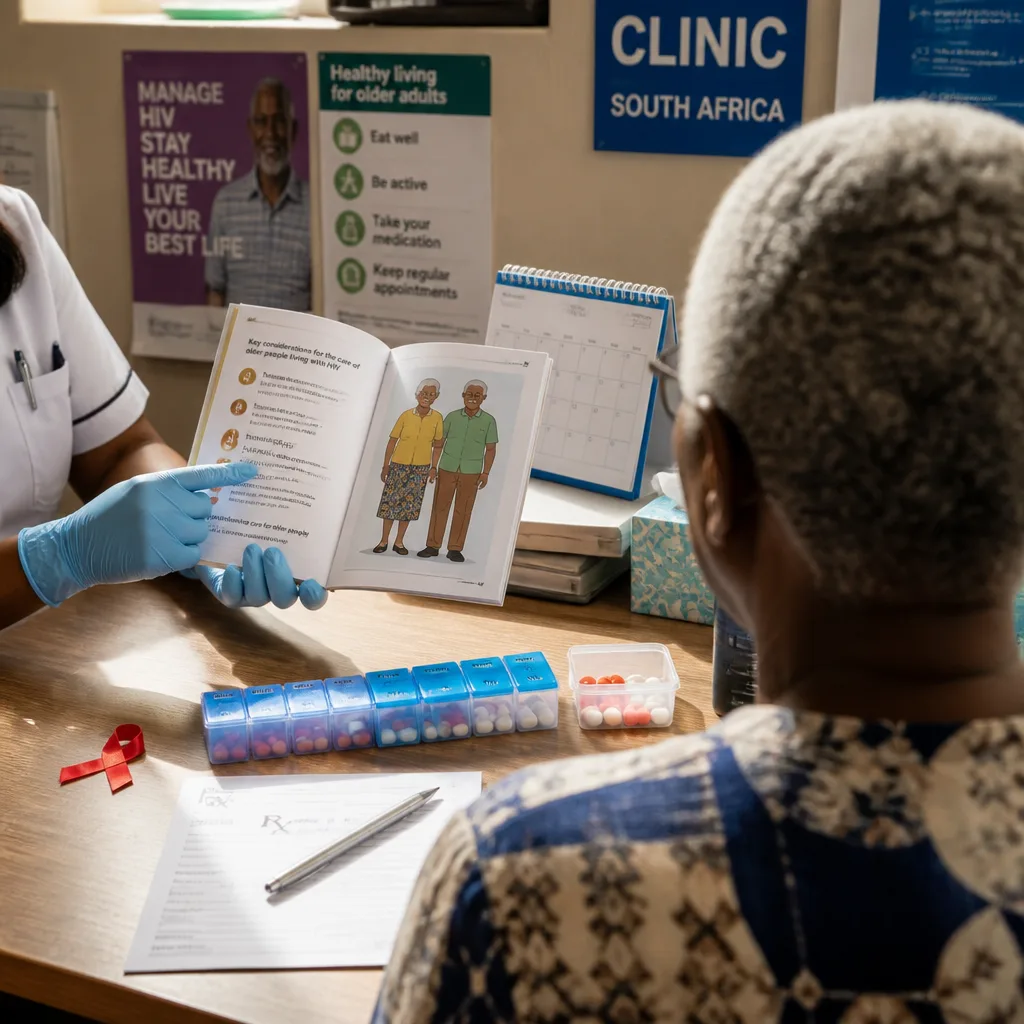
South Africa now has its first dedicated clinical guidance for older people living with HIV, the Southern African HIV Clinicians Society reported in the Southern African Journal of HIV Medicine. The document sets out practical approaches intended to preserve years of good health as the population of people with HIV ages.
Why the guidelines were produced
Antiretroviral therapy (ART) has extended life expectancy for people with HIV, but clinicians and researchers have been raising concerns about the changing care needs of an ageing cohort. The new guidance was developed by about a dozen specialists from across the country, including clinicians working in infectious diseases and palliative care, the Society said.
According to Thembisa, South Africa’s leading HIV mathematical model, there were roughly 1.9 million people aged over 50 living with HIV in 2025 — about 24% of the estimated 7.9 million people with the virus nationwide. Thembisa projects that the over-50 group could rise to more than 3.6 million by 2035.
| Year | People with HIV aged 50+ |
|---|---|
| 2015 | 800 000 |
| 2025 | 1.9 million |
| 2035 (projected) | 3.6 million+ |
Practical focus for a strained system
The guidance aims to be implementable in a resource-constrained public health sector. It recommends structured clinical approaches that account for multimorbidity, frailty, polypharmacy and the social needs common among older patients. Contributors span multiple disciplines, reflecting the complex interactions between HIV, ageing and chronic disease management.
- Recognition that many older people with HIV started ART later in life, affecting long-term outcomes.
- Emphasis on screening and managing comorbid conditions alongside HIV care.
- Advice on medication reviews to reduce risks from polypharmacy.
The guidelines stress that earlier initiation of ART after infection generally improves long-term prognosis. Many people now aged 50 and over were infected earlier in life but received treatment only after ART became widely available in South Africa; the timing of treatment initiation influences later health trajectories.
Implications for health services and policy
A shifting age profile among people with HIV has consequences for clinics, chronic care financing, and workforce training across the public sector. Older patients commonly present with non-communicable diseases such as hypertension, diabetes and chronic kidney disease, which require integrated management alongside HIV care. The guidance provides a framework for that integration but does not, on its own, allocate resources.
Health system planners and provincial departments will need to consider changes to primary care protocols, staff training and medication supply chains to implement the recommendations effectively. The Society framed the guidance as a practical tool to inform clinical practice within existing constraints, rather than a prescriptive national policy.
Longer lives, fewer healthy years without action
While ART has extended life expectancy for people living with HIV, the Society and model projections underline a rising burden of age-related illness among this population. Without adjustments to service delivery and stronger integration of chronic disease care, older patients may face more years of ill health despite living longer.
The new guidelines are likely to shape clinical practice and training in the coming years and could inform policy discussions about how to adapt public health services to meet the needs of a growing, ageing population living with HIV.