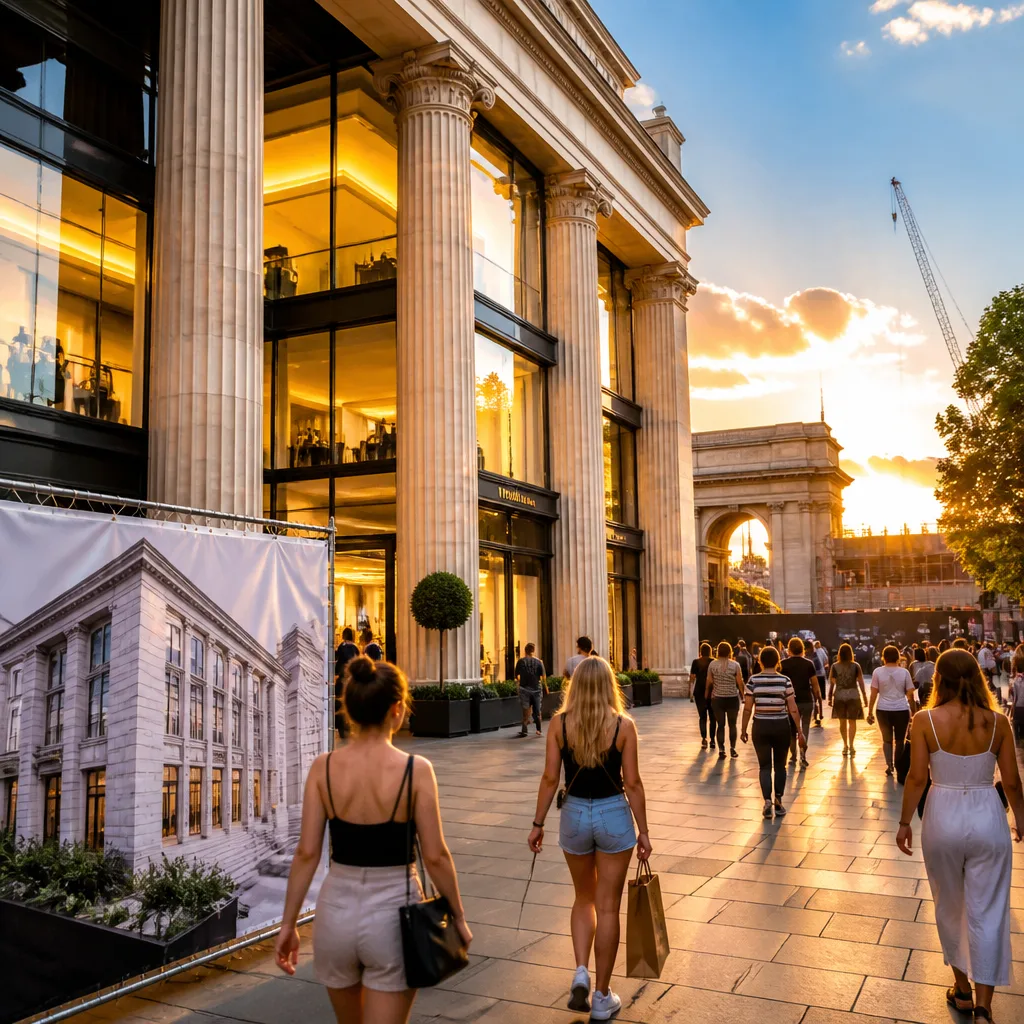
Marks & Spencer has opened a fully revamped flagship on London’s Oxford Street that executives say will act as a template for modernising more than 200 of its large stores nationwide. The overhaul of the 88-year-old Pantheon building — and plans for a controversial redevelopment at Marble Arch — form part of a push to update the 142-year-old group’s in-store experience and shore up online services.
Modernising physical stores and fixing online fragility
At the launch on a hot summer evening, M&S chief executive Stuart Machin told attendees that the business must both “modernise the store experience and modernise the online experience”. The Pantheon project is being presented as a blueprint for a wider roll-out across the retailer’s larger outlets.
The push comes after a difficult 12 months in which a cyber-attack disrupted M&S’s online trading for almost seven weeks, a blow the company says reduced profits by more than £300 million — roughly R6.9 billion by current approximate exchange measures. Machin told shareholders recently that the year ahead was “one of the most important in our history” and that “the next three years are critical for M&S as we invest for growth”.
Flagship choices and local opposition
The Pantheon was rebuilt for M&S in the 1930s after serving earlier as an opera and entertainment house. With the latest refit now complete, attention has turned to the group’s Marble Arch outlet at the other end of Oxford Street. That store, described by Machin as profitable but constrained by low ceilings and a labyrinthine layout, is set to be demolished next year and replaced with a taller, modern building.
The Marble Arch plan was contentious: the new 10-storey design only secured planning permission following a legal challenge and after approval by the housing secretary, Angela Rayner. The proposal has provoked objections over potential environmental and heritage impacts.
“We know we’ve got a big job modernising the store experience and modernising the online experience as well,” Machin said at the Pantheon opening.
Machin, who has been described in reporting as an exacting leader willing to engage with operational detail, is using these projects to imprint his approach on the group four years into the role.
- Pantheon store: 88 years old, now fully refurbished as a prototype for other large stores.
- Group age: M&S was founded 142 years ago.
- Online outage: Almost seven weeks of lost online trading following a cyber-attack, reducing profits by more than £300m (about R6.9bn).
- Marble Arch: Planned demolition and replacement with a 10-storey building after legal challenge and approval by the housing secretary.
| Item | Detail |
|---|---|
| Store count (large stores) | More than 200 |
| Online outage | Almost seven weeks |
| Reported profit impact | More than £300 million (about R6.9 billion) |
For South African observers, the M&S case is a reminder of the twin pressures facing bricks-and-mortar retailers globally: the need to reconfigure physical space to attract consumers while investing in resilient digital systems. A prolonged online outage shows how a failure in technology can erode profits rapidly, while ambitious redevelopment projects can trigger planning battles and community resistance.
Machin’s stated urgency — calling the next three years critical — signals a concentrated period of capital spending and strategic change. Retail landlords, property markets and suppliers could all feel the effects if M&S proceeds to roll out similar refits and rebuilds across its estate. For consumers, the visible changes at key high-street locations may be accompanied by altered product mixes, updated store formats and potentially higher operating costs rolled into pricing over time.
How the retailer balances heritage sensitivities, environmental concerns and the demands of modern retailing will be a test case for other legacy names seeking to remain competitive on high streets under pressure from online rivals and shifting consumer habits.
Details of broader capital allocations and whether the group will prioritise physical store investment versus digital resilience were not disclosed at the opening; the company has framed the Pantheon revamp as the first in a series of significant upgrades that will define its strategy in the years ahead.