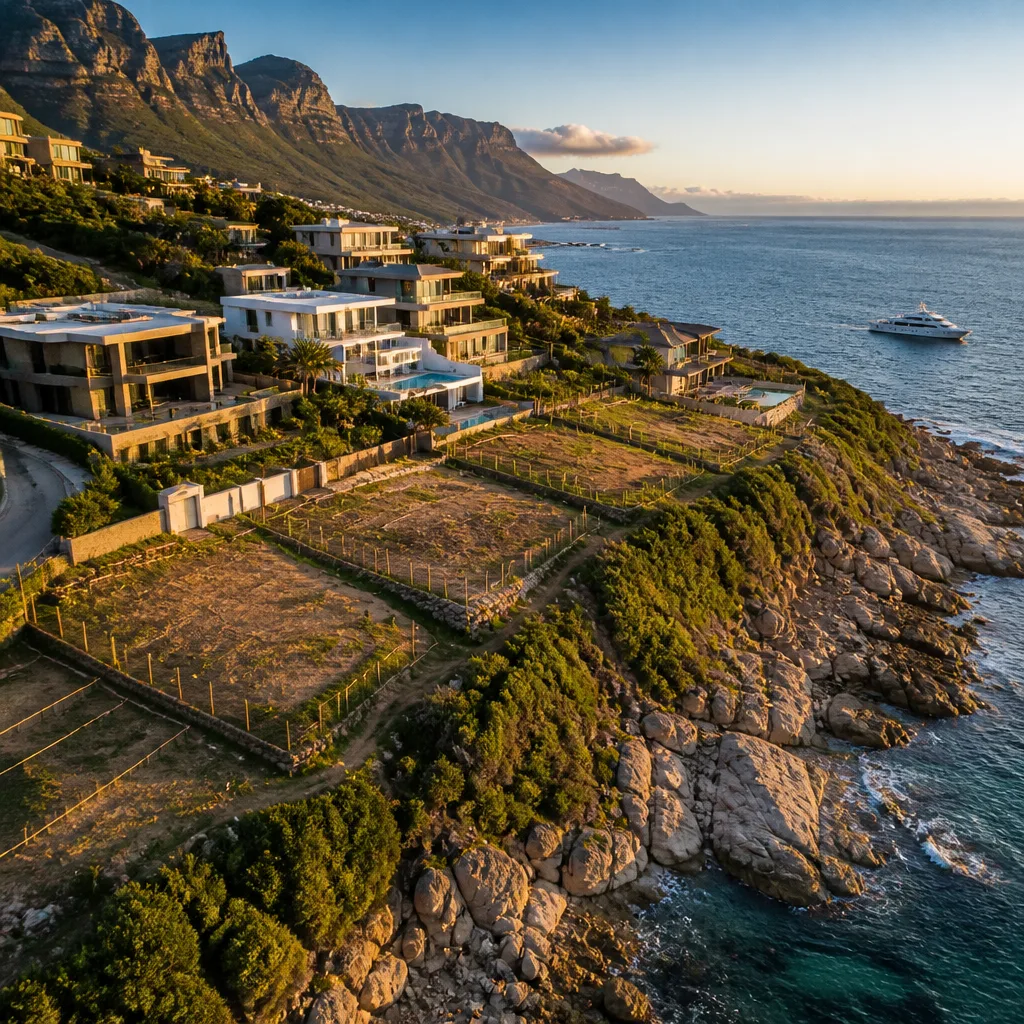
Foreign purchasers are playing a growing role in South Africa’s luxury property market, particularly along Cape Town’s Atlantic Seaboard, where a string of high-value deals has pushed prices to new levels and highlighted rising international interest in the country as an investment destination.
High-end deals underscore overseas demand
Real estate industry figures cited a number of headline transactions that illustrate the trend. Two adjoining vacant stands measuring 2,700m² in Clifton were sold last year for R170m to a Spain-based multinational entity, reportedly with plans to develop a substantial trophy residence on the site. Elsewhere on the Atlantic Seaboard, brokers recorded sales including a R92.5m three-level designer home in The Glen, Camps Bay; a R78m multilevel modernist mansion bought by a Mexican buyer; and a R53m villa in Bantry Bay acquired by an investor from Cameroon.
Those transactions follow the launch of an international luxury property network in South Africa by Forbes Global Properties, an invitation-only network for top-tier brokerages. Keegan Steyn, chief executive officer, described the rollout as a response to what he characterised as “exponential” growth in foreign buyer interest and said he saw significant untapped opportunity beyond traditional source markets.
“The country remains largely untapped with huge growth potential,” Keegan Steyn said, according to reporting.
Where buyers are coming from
Industry representatives pointed to a diversification of buyer origins. Ross Levin, licensee for Seeff Atlantic Seaboard and City Bowl, said there has been a noticeable increase in purchases from the UK, Germany, the Netherlands, France and the United States over the past two to three years. Levin attributed part of this shift to economic weakness in parts of Europe and heightened geopolitical tensions in Eastern Europe and the Middle East, while noting Cape Town’s lifestyle and climate as durable attractions for overseas purchasers.
Data cited from Western Cape residential sales records (PropStats) showed that in the first half of 2026, 17 of the 48 sales priced above R20m on the Atlantic Seaboard—about 35%—involved international buyers. In the same period, foreign nationals were responsible for two of the six sales that exceeded R50m.
Market implications and context
The influx of high-net-worth foreign buyers has several implications. It elevates price benchmarks in prestige suburbs and can contribute to a two-tier market where ultra-prime values diverge from the broader residential market. At the same time, such transactions can attract further international brokerage activity and capital flows, particularly into coastal and lifestyle nodes that appeal to holiday-home purchasers and investors.
Industry sources framed the trend as part of a broader repositioning of South Africa within global property investment circuits. The arrival of a selective international network of brokerages signals both confidence from overseas intermediaries in South African luxury real estate and a marketing push to connect affluent buyers to local listings.
- Notable high-value sales on the Atlantic Seaboard include R170m, R92.5m, R78m and R53m transactions.
- PropStats data: 35% of R20m-plus sales in H1 2026 on the Atlantic Seaboard went to international buyers.
- Brokers report increased purchases from the UK, Germany, the Netherlands, France and the US.
| Price band | H1 2026 Atlantic Seaboard sales | International buyer share |
|---|---|---|
| > R20m | 48 | 17 (35%) |
| > R50m | 6 | 2 |
While these headline transactions attract attention, they represent the uppermost segment of the market. Observers note that the broader residential market’s dynamics—affordability, supply of mid-market housing, and domestic demand—remain driven by local economic conditions. Luxury transactions, however, can set price references and spur investment into complementary services and luxury development.
As South Africa features increasingly on the radar of wealthy international buyers, industry participants will be watching whether rising interest translates into sustained activity beyond the most exclusive suburbs, and whether that capital inflow alters supply, taxation and planning debates at municipal and provincial levels.