South Africa used its first month-long National Science Month to showcase a string of local research achievements that span energy, astronomy, agriculture and computing. Under the theme Science, Technology and Innovation Are for Everyone, researchers and institutions presented projects intended to move laboratory ideas into everyday South African use.
Home-grown electrolyser aims to accelerate green hydrogen work
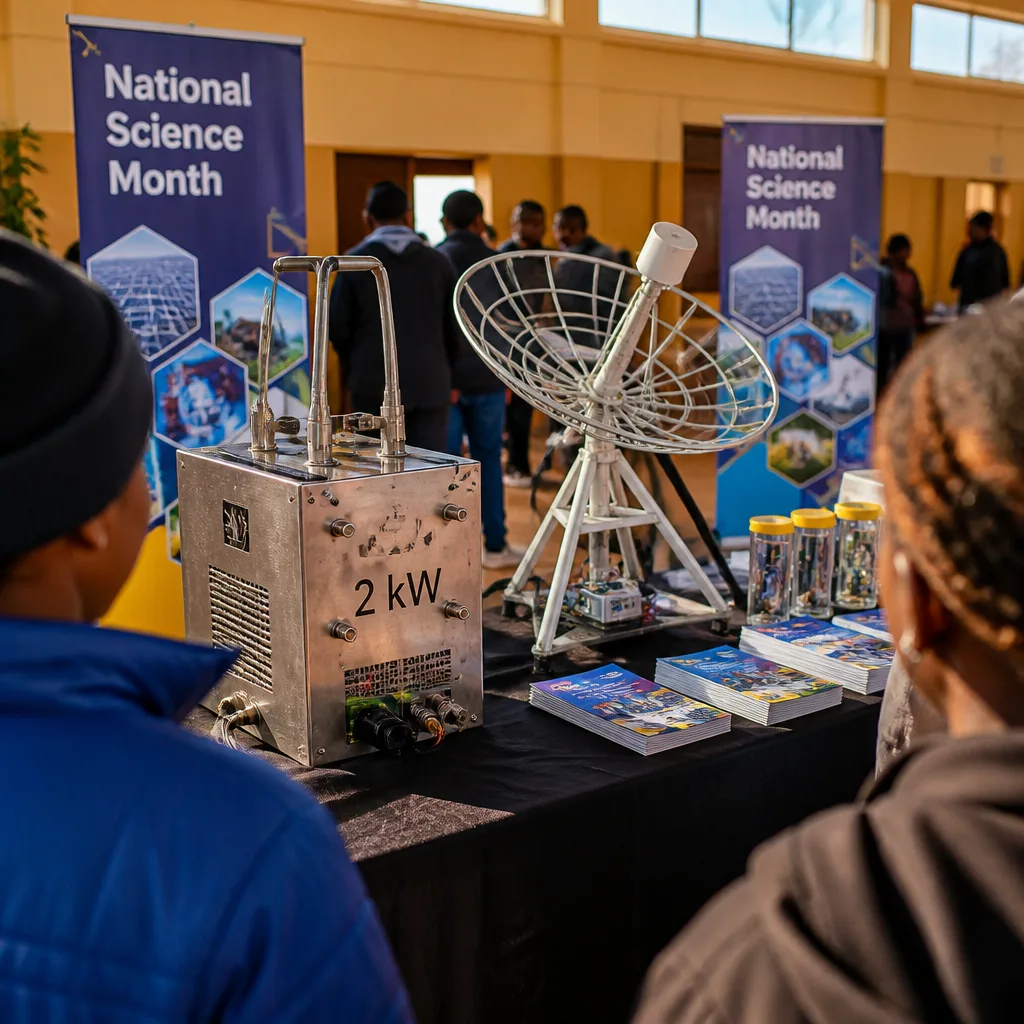
One of the most widely noted demonstrations came from Sasolburg, where scientists unveiled a locally developed Proton Exchange Membrane electrolyser with a rated capacity of 2kW. An electrolyser uses electricity to split water into hydrogen and oxygen; when powered by renewable electricity, the resulting hydrogen can serve as a lower-carbon fuel for transport and heavy industry.
The device was developed using publicly funded South African intellectual property and a research partnership involving the Department of Science, Technology and Innovation, North-West University, the South African National Energy Development Institute and Sasol. The team will use the laboratory-scale machine to test green hydrogen approaches under South African weather and renewable-energy conditions. The broader implication is capacity building: researchers are producing local know-how rather than relying entirely on imported technology.
Smaller, cheaper astronomy — a radio telescope in Hammanskraal
Outside Hammanskraal, a compact, low-cost Transient Array Radio Telescope (TART) has been installed to give researchers and community members access to radio astronomy. Unlike optical telescopes that collect visible light, a radio telescope detects radio waves from space. The open-source instrument can monitor large swathes of sky and track objects such as satellites, near-Earth objects and brief transient events.
The TART system, first installed in 2025, returned to public attention during National Science Month through a four-day workshop that brought the project and its educational potential to the fore.
Other highlights: biology, plants and more citizen-facing research
The month-long showcase also highlighted a range of other scientific advances made locally. The selection of stories presented in the National Science Month summary included:
- Research into hydrogen technology intended to anchor a domestic green-hydrogen capability;
- Low-cost radio astronomy hardware and community engagement around the TART installation;
- Biological research and other science stories that demonstrate how local teams are addressing South African challenges in agriculture and industry;
- A wider effort to take science out of the laboratory and make it visible and relevant to ordinary South Africans.
National Science Month was positioned as an expanded version of the pre-existing National Science Week and was explicitly framed to bring research closer to the public and to show how science shapes daily life.
What this means for policy and inclusion
The events and demonstrations point to two connected questions for policymakers and funders: what will it cost to scale laboratory prototypes such as the 2kW electrolyser to commercial or industrially useful capacity, and who will be able to access the benefits and jobs that follow? The hydrogen device is a laboratory-scale demonstrator; the process of moving from a 2kW bench unit to a utility-scale system requires further investment, regulation and industry partnerships.
Similarly, open-source, low-cost instruments such as the TART radio telescope show how technology can widen participation in science. But scaling participatory projects across provinces requires funding, training and infrastructure such as connectivity and stable power — challenges that remain uneven across urban and rural areas.
| Project | Focus |
|---|---|
| 2kW PEM electrolyser | Green hydrogen research and local technology development |
| TART radio telescope | Low-cost radio astronomy and community engagement |
National Science Month showcased these and other projects to underline a central message: developing scientific capacity locally is not only about invention, but also about building the skills, partnerships and public understanding required to translate research into jobs, services and climate solutions. The successes celebrated in July raise practical questions about scale, cost and equitable access that South African government departments, universities and industry will need to address in the months ahead.