
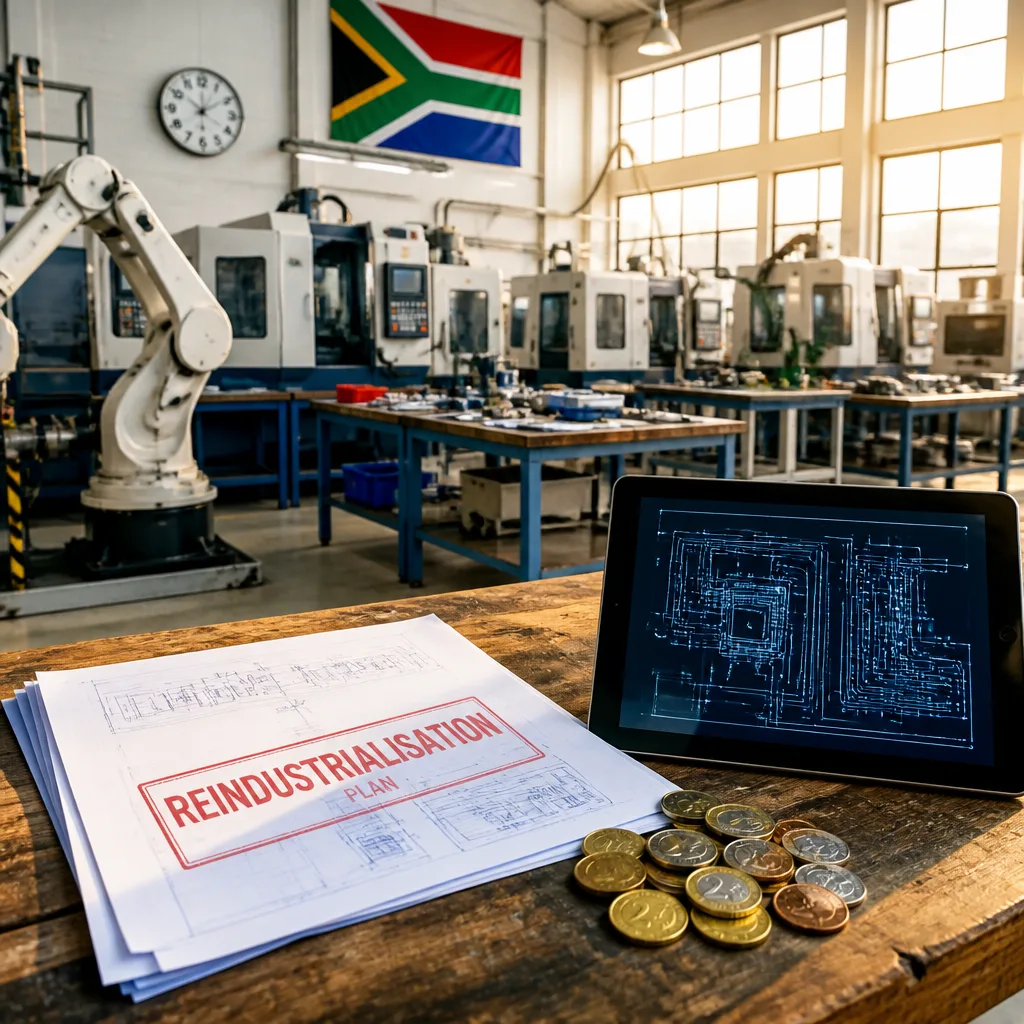
South Africa’s manufacturing sector has shrunk considerably since democracy, and reversing that trend will require more than policy rhetoric: it needs patient finance, coordinated public‑private action and targeted technological upgrading, argues Dr Khwezi Mabasa in an opinion piece reported by SABC News.
Manufacturing’s steady decline
Dr Mabasa notes that the manufacturing share of gross domestic product fell from 21% in 1994 to 12% in 2024. More recent Statistics South Africa data cited in the piece show a further contraction of 2.8 percentage points in the past year, underscoring a structural challenge that affects diversification, job creation and technological upgrading across the economy.
The piece identifies a core obstacle: conventional commercial finance tends to favour short‑term returns and low risk, leaving capital‑intensive, long‑gestation industrial projects underfunded. That financing gap, combined with weak competitiveness in emerging sectors, has hampered efforts to expand domestic production capacity.
Role of development finance
According to the article, the Industrial Development Corporation (IDC) has sought to fill that gap by providing what is often called "patient capital" and concessional financing to sectors viewed as critical for reindustrialisation. In the 2024/25 financial year the IDC reportedly extended concessional support to targeted areas, including the clothing and textile, manufacturing more broadly, and downstream steel segments.
| Sector | Concessional finance (2024/25) |
|---|---|
| Clothing and textile | R459 million |
| Manufacturing (general) | R974 million |
| Downstream steel | R157 million |
These interventions are presented as examples of how concessional funding can preserve jobs and deliver multiplier effects beyond immediate financing, including non‑financial support to businesses.
Three priorities for reindustrialisation
Dr Mabasa argues that reindustrialisation requires a coordinated effort across government, development finance institutions, private capital and industry. The opinion sets out three broad priorities, the first of which is expanded access to concessional industrial finance tailored to the specific demands of rebuilding productive capacity.
- Access to patient finance: Longer time horizons and risk‑tolerant capital are needed for capital‑intensive projects and to support smaller enterprises that conventional lenders often overlook.
- Support for smaller firms: Beyond loans, firms need technical and non‑financial assistance to adopt new technologies and scale production.
- Deepening transformation: Finance and policy must be shaped to broaden participation and competitiveness in emerging sectors, so benefits are more widely shared.
The article frames these priorities as complementary: finance without technical support may fail, while technology adoption without accessible capital will remain limited.
What this means for technology and policy
For technology observers and policymakers, the piece raises practical questions about who benefits from industrial financing and how public development institutions can crowd in private investment without repeating past failures. It also highlights that rebuilding productive capacity is as much about upgrading skills, production processes and value chains as it is about moving funds from balance sheets into factories.
Targeted concessional finance can help firms invest in automation, clean production and digital technologies that raise productivity, but the distributional question is central: which firms will receive this finance, and how will smaller enterprises and historically disadvantaged entrepreneurs be supported to adopt and sustain new technologies?
Dr Mabasa’s analysis, as reported by SABC News, does not offer a detailed implementation plan but underscores that reversing the decline in manufacturing will require persistent, coordinated interventions by state and non‑state actors, anchored by patient, sector‑sensitive finance.