
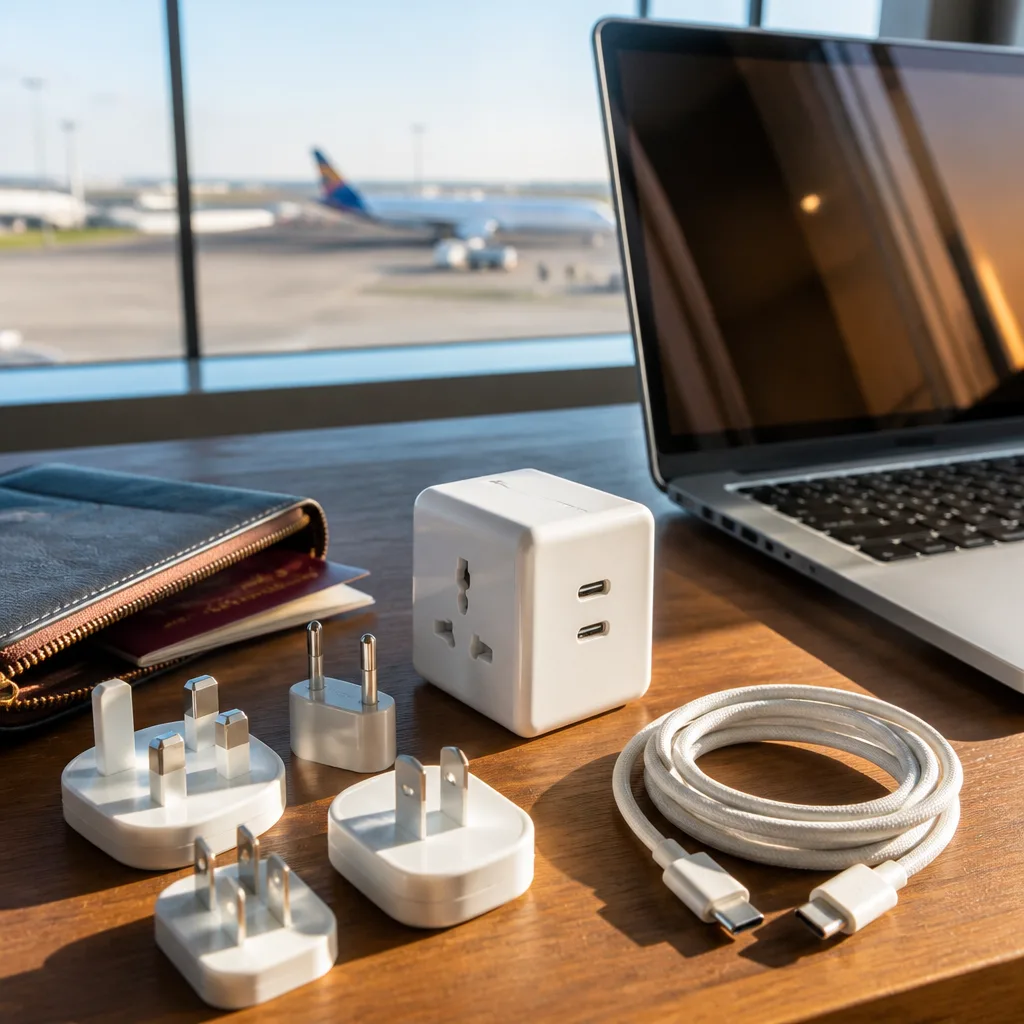
Frequent travellers and anyone juggling multiple devices will welcome a universal adaptor that can finally keep pace with modern laptops. The Ceptics 140W Universal Travel Adaptor combines broad plug compatibility with a high-power USB output that can charge demanding machines at full speed.
What's new: more power, same convenience
Universal adaptors have long been useful for replacing a pile of regional plugs, and most include USB ports for phones and tablets. What sets this model apart is the headline figure: 140W maximum USB output, delivered via USB-C ports under the USB Power Delivery (PD) 3.1 specification with the 28V Extended Power Range profile. That is the practical ceiling for a single USB-C connection under PD 3.1 and is enough to charge larger laptops — a useful step up from the 30W–65W outputs common on earlier adaptors.
The adaptor accepts a very wide range of input plug types — covering Europe, North America and many Asian and African standards — and outputs through the commonly used Type A, Type C, Type G and Type I plug faces. It is aimed at travellers who need to charge several devices at once while avoiding heavy wall bricks that can pull adaptors from sockets.
Key specifications
| Feature | Detail |
|---|---|
| Product type | Universal travel adaptor (model UP-140KU) |
| Accepted plugs | Type A, B, C, E, F, G, H, I, J, K, L, N, O |
| Output plug faces | Type A, Type C, Type G, Type I |
| AC input sockets | 2 (1 universal, 1 USA/JP) |
| USB ports | 1 x USB-A, 3 x USB-C |
| Maximum USB output | 140W total (PD 3.1, 28V/5A on C1 and C2) |
| Charging protocols | PD 3.1, QC4+, FCP, AFC, PPS, BC1.2 |
| AC rating | 100–250V, 10A max, 2500W |
Practical benefits for travellers
- Full-speed laptop charging: With PD 3.1 and a 28V/5A profile on its primary USB-C ports, the adaptor can charge high-power laptops such as 16-inch models that previously needed dedicated power bricks.
- Multiple devices at once: Three USB-C ports plus a USB-A port and two AC sockets mean you can power a laptop, phone, power bank and a small appliance simultaneously.
- Less bulk at the wall: Built-in USB ports remove the need for a separate USB wall brick, reducing the weight and preventing heavy plugs from leveraging the adaptor out of the socket — a common annoyance with some setups.
One trade-off noted in the review is the absence of a built-in cable. Some rival units include integrated leads, which are convenient but can add complexity or limit replacement options. The Ceptics unit favours raw output capacity instead: the review describes this as an acceptable compromise for users who already carry a selection of USB-C cables or prefer to swap cables as needed.
Who should consider it?
This adaptor is aimed at people who travel often and carry higher-power laptops, or those who want a compact way to charge multiple devices while abroad. If you typically only need to top up a phone and tablet, the extra power may be more than you need. But for business travellers, digital nomads and anyone who dislikes packing heavy power bricks, the step up to 140W could be a meaningful convenience.
Technical buyers will also appreciate the broad protocol support — PD 3.1, QC4+, FCP, AFC, PPS and BC1.2 — which helps ensure compatibility across chargers and devices. The adaptor's AC rating of 100–250V and a maximum of 2500W also means it will function across the wide range of mains voltages encountered internationally.
For South African travellers planning overseas trips, or anyone buying global-ready tech, this adaptor is a practical option to consider when comparing travel power kits. It reduces the need for separate bricks while delivering the power modern laptops demand — provided you bring your own USB-C cables.