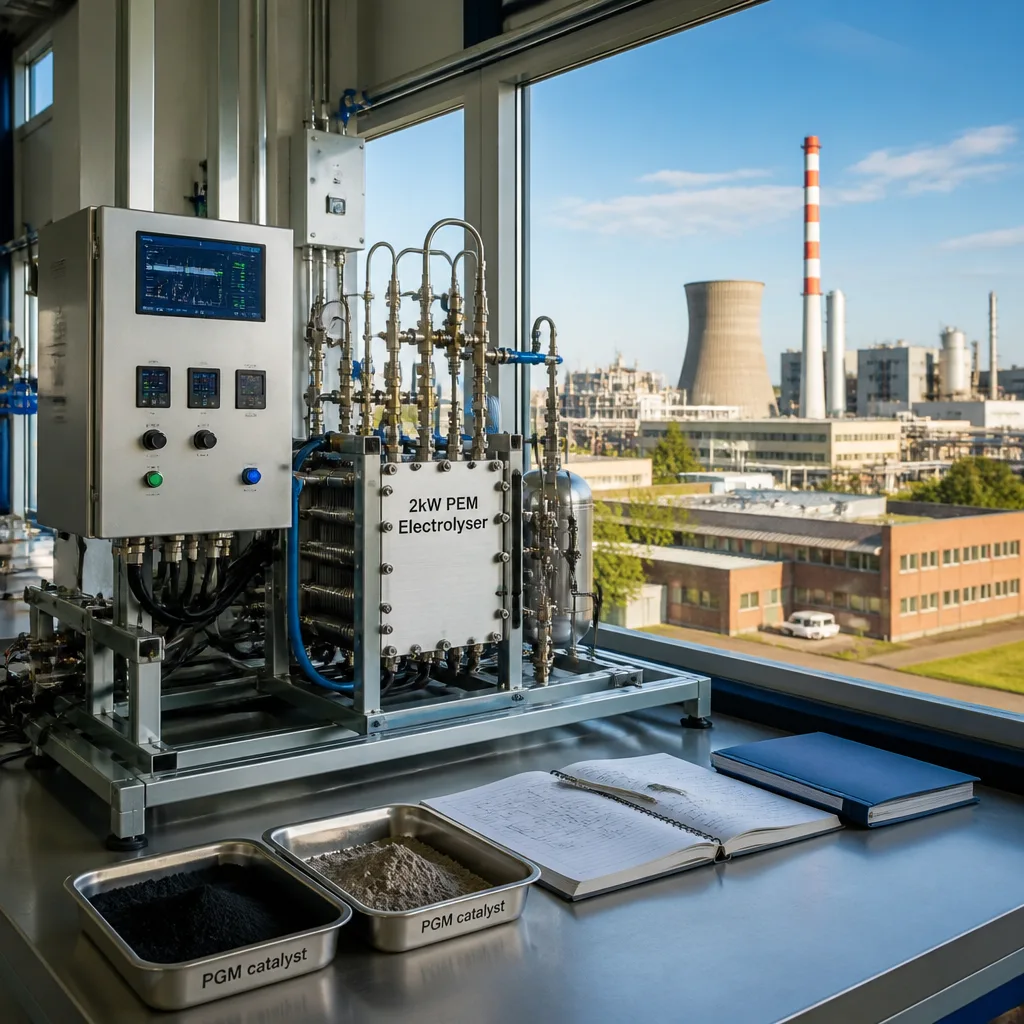
Sasol, together with public-sector partners and an academic institution, has commissioned a 2 kW proton exchange membrane (PEM) electrolyser at its Research and Technology campus in Sasolburg, the company and partners announced on 31 July. The system is intended as a testbed for hydrogen production methods, an evaluation platform for locally developed electrolyser technology under variable renewable energy conditions and a facility for skills development.
Public‑private collaboration targets local capability
The project brings together Sasol, the Department of Science, Technology and Innovation’s Hydrogen South Africa programme (HySA), the South African National Energy Development Institute (SANEDI) and North‑West University. Each stakeholder contributed to the development and commissioning of the electrolyser, which the partners say will help generate the knowledge required to support future commercial deployment of green hydrogen technologies in South Africa.
Science, Technology and Innovation Minister Professor Blade Nzimande addressed delegates at the launch, emphasising the link between the country’s critical minerals and its clean‑energy ambitions. He highlighted the role of platinum group metals in electrolyser technology and said the project looked to advance local beneficiation and participation across upstream, midstream and downstream segments of future industries.
“The relationship between critical minerals, beneficiation and green hydrogen in the context of the DSTI's Renewable Energy agenda is key. Central to the deployment of this 2 kW PEM electrolyser system is the beneficiation of critical minerals, particularly platinum group metals,” Minister Nzimande said.
What the facility will do
According to the partners, the small‑scale PEM electrolyser is designed primarily for research and development rather than immediate commercial hydrogen production. Its stated uses include:
- testing hydrogen production technologies at a system level;
- evaluating components and systems developed locally under variable renewable energy inputs;
- building skills and generating data to inform scale‑up and commercialisation pathways.
The stakeholders said insights from the platform should inform efforts to make green hydrogen production more efficient and commercially competitive, extend export offerings and stimulate domestic use of hydrogen in pursuit of a net‑zero economic future.
Context: minerals, manufacturing and skills
South Africa’s endowment of platinum group metals places the country in a strategically relevant position for PEM electrolyser development, since these materials are key to many electrochemical devices. The launch explicitly links the electrolyser to a broader agenda of beneficiation — moving beyond raw exports to capture value in manufacturing and downstream applications.
The partners framed the unit as an early step in a long chain: from laboratory research and pilot hardware to demonstration projects and, ultimately, commercial systems. They also underscored skills development as a core objective — producing technicians, engineers and researchers who can operate, test and improve electrolyser technologies.
| Stakeholder | Role |
|---|---|
| Sasol | Host and industry partner; provided R&T campus facilities |
| DSTI / HySA | Programme support for hydrogen research and development |
| SANEDI | State energy research institute partner |
| North‑West University | Academic contributor to technology development and training |
Implications and limits
While the 2 kW PEM electrolyser is modest in scale compared with commercial units, the partners describe it as an important experimental platform. Its primary value lies in enabling tests under variable renewables, validating locally produced components and widening the pool of engineers and researchers experienced with hydrogen hardware.
However, the commissioning does not equate to immediate mass production of green hydrogen or the rapid establishment of domestic manufacturing capacity. The partners said the knowledge generated would inform future steps toward efficiency improvements and scaled production, but did not provide timetables or investment figures for commercial roll‑out.
For policymakers and industry, the project raises several practical questions that will shape next phases: how to translate laboratory and pilot findings into competitive industrial designs; how to finance scale‑up; and who will benefit from new manufacturing and export opportunities.
The electrolyser project sits alongside a growing conversation about South Africa’s role in the global hydrogen economy — one that hinges on critical minerals, industrial strategy and skills. As partners move from pilot tests to larger demonstrations, the focus will be on proving performance, lowering costs and ensuring that the economic gains extend beyond a handful of stakeholders.