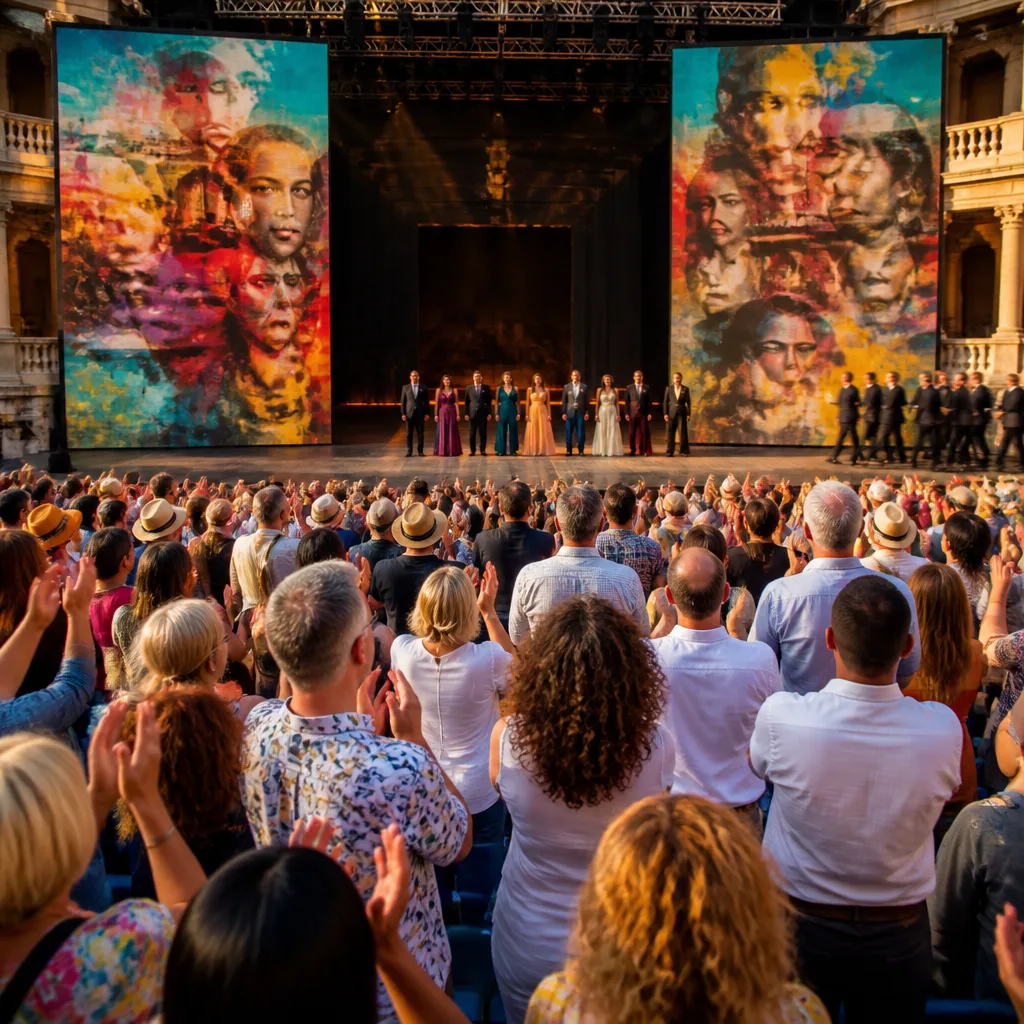
Artificial intelligence was at the centre of a polarising staging of Richard Wagner’s Der Ring des Nibelungen at Bayreuth as the festival marked the 150th anniversary of the full cycle.
AI imagery divides audience at historic festival
The production, titled “10010110” — binary for 150 — was subtitled “From Myth to Code” and used multiple AI models to select and project images drawn from a digital archive of previous Bayreuth productions. Performances ran across four nights, totalling about 14½ hours of staging, with singers positioned between two expansive screens and minimal blocking.
Curator Marcus Lobbes developed the concept alongside Nils Corte and dramaturge Andri Hardmeier. The creative team fed computers roughly 1,000 images culled from the 15 prior Bayreuth Ring productions; Stable Diffusion was used to seed each act with the 1876 scenery designed by Gotthold Brückner and Max Brückner from sketches by Josef Hoffmann, after which the software selected imagery according to text and score.
“We always communicated that it’s an experiment, it’s not stage-directed,”
The experimental approach intended to enact a history of the Ring rather than a single, cohesive dramatic interpretation. That framing did not, however, prevent a vociferous audience response. At the final night, following Götterdämmerung, conductor Christian Thielemann and the cast were met with a sustained 17-minute ovation. The applause was punctured by roughly 30 seconds of boos and whistles when the production team came forward for bows.
Context and reception: history of controversy at Bayreuth
Bayreuth has a long history of audience turbulence around innovative stagings. The reporting recalled Patrice Chéreau’s centennial 1976 production, which initially provoked outrage for relocating Wagner’s drama to the context of the Industrial Revolution; that staging was later reassessed and widely praised, receiving a prolonged ovation in 1980.
Festival organisers and the creative team framed “10010110” as an experimental collage — an “encyclopaedia of interpretations” — rather than a conventional new production. The minimal movement of singers, who often remained largely stationary across the four nights, was consistent with the stated intent to prioritise visual history curated by algorithms over traditional stage direction.
What the experiment entailed
- Title: “10010110” (binary for 150)
- Subheading: “From Myth to Code”
- Visual sources: about 1,000 images from 15 previous Bayreuth Ring productions
- Technical tools: multiple AI models, including Stable Diffusion to initialize scenery imagery
- Performance length: roughly 14½ hours over four nights
| Item | Detail |
|---|---|
| Anniversary | 150th anniversary of the full cycle’s premiere (first given in 1876) |
| Audience reaction | 17-minute ovation; ~30 seconds of boos/whistles |
| Creative leads | Marcus Lobbes, Nils Corte, Andri Hardmeier |
The experiment provoked a larger question about the role of algorithmic curation in live performance: while AI can generate and assemble striking imagery, critics in the audience suggested it could not produce the dramatic coherence expected in a Wagnerian experience, where staging, music and dramaturgy traditionally interlock in highly specific ways.
Yet the lengthy ovation for the musicians and singers indicates that the musical performance, led by Thielemann and the cast, retained strong support among festivalgoers even as the visual concept divided opinion. The mixed reaction underscores Bayreuth’s continuing role as a testing ground for ambitious re-readings of canonical repertoire — and a reminder that innovation at the festival often arrives with contestation.
Whether “10010110” will be reassessed over time, as happened with Chéreau’s controversial 1976 staging, remains to be seen. For now the production has reopened familiar debates about fidelity to composer intent, the value of experimental forms, and the expanding place of artificial intelligence in the arts.