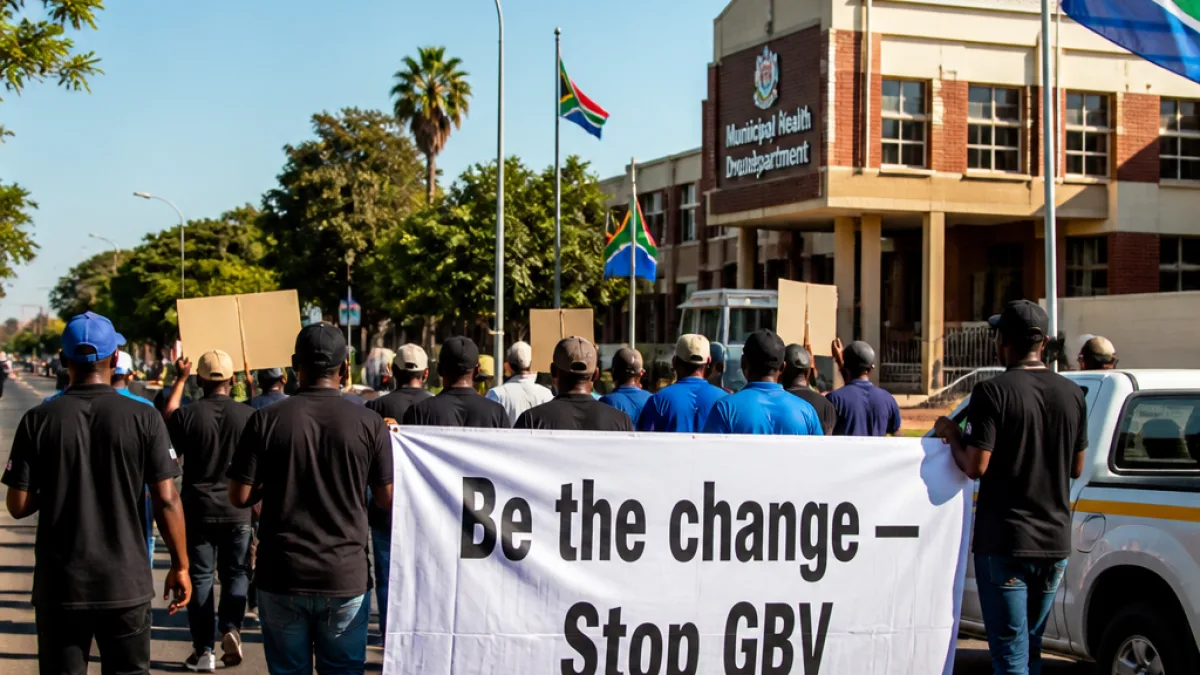
POLOKWANE — The Limpopo Department of Health has placed men at the centre of its latest campaign to curb gender-based violence (GBV) after Health MEC Dieketseng Mashego led a provincial men’s walk under the theme “Be the change, be the voice, be the protector, stop gender-based violence.”
The March is the department’s attempt to mobilise men and boys to challenge violent behaviour in homes and communities and to support victims, the MEC’s spokesperson, Percy Moagi, said. The department said its aim is to encourage men who experience abuse themselves to come forward and seek help.
“Both men and women should not experience GBV in their lifetime,”
Moagi urged men to intervene when they witness abusive conduct instead of staying silent and to adopt non-violent ways of managing anger. He added the department believes the responsibility for ending GBV extends across society, not only to government agencies.
What the department urged
- Speak out: Men and boys should report and challenge abusive behaviour.
- Support survivors: Encourage those affected to seek help from available services.
- Address male victimhood: Men who experience violence should be recognised and assisted.
- Community responsibility: GBV must be treated as a societal problem, not confined to a single department.
While the walk is a visible symbol of commitment, stakeholders and community members who follow Limpopo affairs will gauge its impact on whether the words translate into services, funding and sustained outreach. The department did not, in its public statements, provide figures for new spending, programme expansion or timelines for measurable outcomes.
Questions about resourcing and coordination
For many observers the critical test is how the march links to concrete interventions: counselling and trauma services, clinical forensic services for survivors, training for health workers, and programmes that target perpetrators. The department’s emphasis on men intervening in their communities is necessary, but it raises immediate operational questions: who will train and support these community actors, and where will the funding come from?
National and provincial strategies have repeatedly highlighted the need for cross-sector coordination between health services, social development, education, police and community organisations. Moagi framed the issue as a collective responsibility, but did not outline how departments and civil society will coordinate at ground level across Limpopo’s districts.
| Priority | Action called for |
|---|---|
| Prevention | Encourage men to speak out and challenge peers |
| Support | Encourage survivors, including men, to access help |
| Community role | Treat GBV as a societal problem beyond single departments |
Health departments are only one part of the response. Police capacity to investigate GBV, availability of shelters, social-work caseloads and community-based prevention programmes are all necessary pillars. Neither the department’s statement nor Moagi’s comments detailed steps to shore up these complementary services in Limpopo.
Implementation questions are particularly pressing in rural and poorly resourced areas of the province where access to clinical forensic services and psychological support is limited. Campaigns that call on men to intervene must be matched by training, safe referral pathways and consistent funding for front-line workers.
Moagi also highlighted the need to recognise men as potential victims, advising those who experience violence themselves to speak out. That emphasis addresses an often-overlooked element of GBV programming, but it again prompts queries about whether male survivors have accessible, male-sensitive services in the province.
Progress in reducing GBV will depend on sustained action beyond high-visibility events. The department’s public appeal is clear: men must be active participants in preventing violence. The unanswered questions now concern the budget, interdepartmental coordination and measurable targets that will translate the march’s message into outcomes for victims and communities across Limpopo.
Who to contact — People needing assistance with GBV can consult local health facilities, social-development offices, or SAPS stations in their area for referrals. The department’s public communications reiterated the importance of seeking professional help but did not list new helplines or funding allocations.
As the province marks this renewed push, attention will turn to whether the call for men to “be the voice” becomes a funded, monitored and evaluated strand of the province’s broader GBV response.