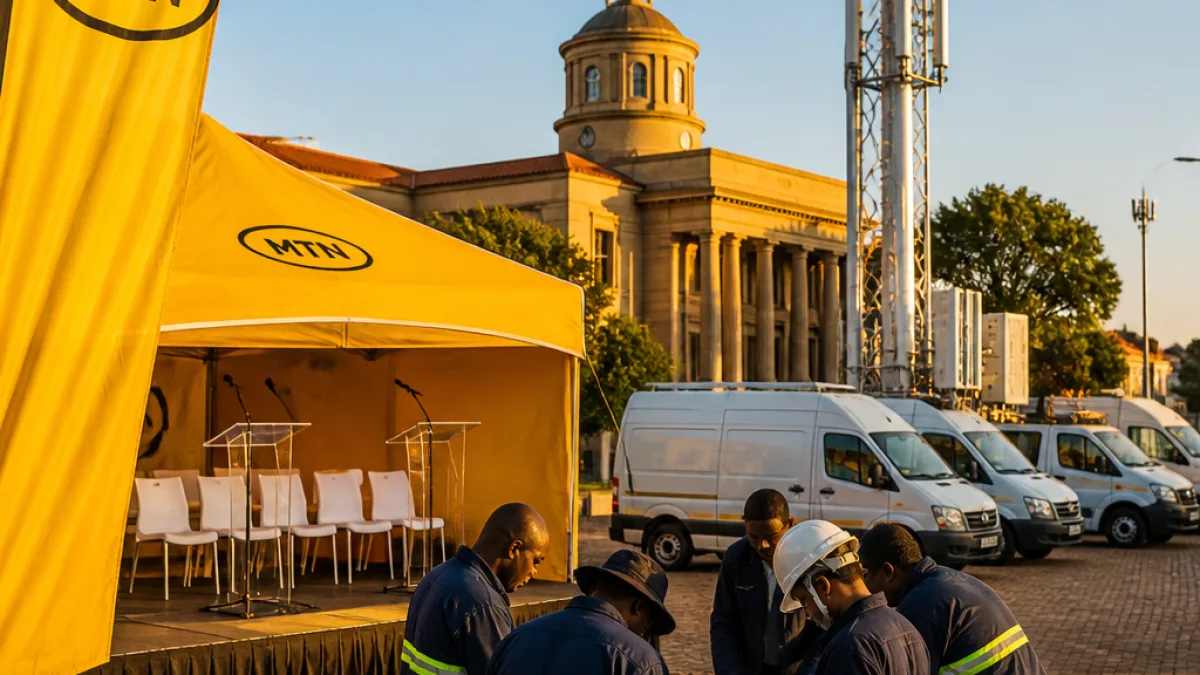
MTN earmarks R332 million to bolster Limpopo connectivity
MTN South Africa has allocated R332 million to expand and modernise its network infrastructure in Limpopo during 2026, company executives announced during a provincial engagement this week in Polokwane. The commitment targets improved 5G coverage, increased network capacity and enhanced service resilience for communities, businesses and public institutions across the province.
The investment was disclosed on the latest stop of MTN’s countrywide tour led by Deputy Chief Executive Yolanda Cuba, who met provincial leaders, municipal representatives and local stakeholders. During the visit MTN executives held talks with Limpopo MEC for Health Dieketseng Masesi Mashego and Polokwane Executive Mayor John Mpe.
What the R332m will finance
MTN said the funds will be used to expand 5G coverage and to modernise existing network sites. Company figures show the operator already runs about 1,000 LTE-enabled sites in Limpopo and more than 100 active 5G sites.
- Deploy over 100 Massive MIMO upgrades during 2026
- Modernise 38 network sites across the province
- Boost network capacity and service resilience for communities and businesses
“providing communities and businesses with access to reliable, high-speed connectivity”
Massive multiple-input multiple-output (Massive MIMO) is an advanced wireless technology that increases spectral efficiency by using multiple antennas at base stations to serve many users simultaneously. The upgrades are aimed at delivering higher throughputs and supporting growing data demand.
Context: group and national capex
Locally, MTN’s South Africa unit spent R8.4 billion on its network in the year to end-December 2025, down from R9.4 billion in 2024, the company reported. At a group level, MTN has guided capital expenditure for its 2026 financial year at between R39.1 billion and R48.6 billion (excluding leases), based on revenue growth expectations of between 15% and 19% and a target capex intensity of 15%–18%.
In March, MTN South Africa committed to a separate pledge of almost R22 billion over three years to expand capital infrastructure locally, aligning with government efforts to attract investment. For comparison, rival Vodacom spent R11.87 billion on its South African network for the year to end-March and is expected to reach about R12 billion in its 2027 financial year.
Why this matters for Limpopo residents and businesses
Improved 5G and upgraded LTE capacity can reduce congestion on busy cell sites, improve data speeds and lower latency for services that increasingly underpin public health, education and commerce. In a province with urban centres such as Polokwane and extensive rural areas, network resilience can be decisive for emergency communications, e-learning initiatives, public health reporting and digital small-business activity.
Yet capital commitments raise questions about roll-out priorities and timelines. The company has not published a detailed schedule for which towns or wards will receive upgrades first, nor the expected completion dates for the 38 modernised sites. Residents and municipalities will be looking for clarity about where the new sites will be sited and whether public institutions — clinics, schools and local government offices — will be prioritised.
Accountability: following the money
Trackable details matter. The headline figure of R332 million is significant for a single province, but the public will want to know:
- Which specific towns and wards receive the upgrades and when;
- How much of the allocation covers new site builds versus equipment upgrades or leases;
- What measures will be taken to reduce potential environmental and community impacts around new mast sites;
- How MTN will coordinate with the provincial government and municipalities to prioritise public-sector connectivity needs.
| Metric | Figure |
|---|---|
| LTE-enabled sites in Limpopo | ~1,000 |
| Active 5G sites | >100 |
| Planned Massive MIMO upgrades (2026) | >100 |
| Sites to be modernised (2026) | 38 |
| MTN South Africa network spend (year to Dec) | R8.4bn |
Provincial officials present at the engagements welcomed the commitment but did not provide a procurement or siting schedule. Municipalities will now need to follow up to ensure roll-out aligns with local development needs and planning approvals.
For households and small businesses, the immediate practical questions concern timing and affordability — when will speeds improve, and will data packages remain competitively priced as capacity grows? For government and large users, the focus will be on whether network resilience improvements reduce downtime and support critical services.
MTN’s R332 million pledge is a meaningful injection for Limpopo’s digital infrastructure. The next step is monitoring how that money is spent on the ground and whether promised upgrades translate into measurable improvements in coverage, speed and reliability for the province’s residents and economy.