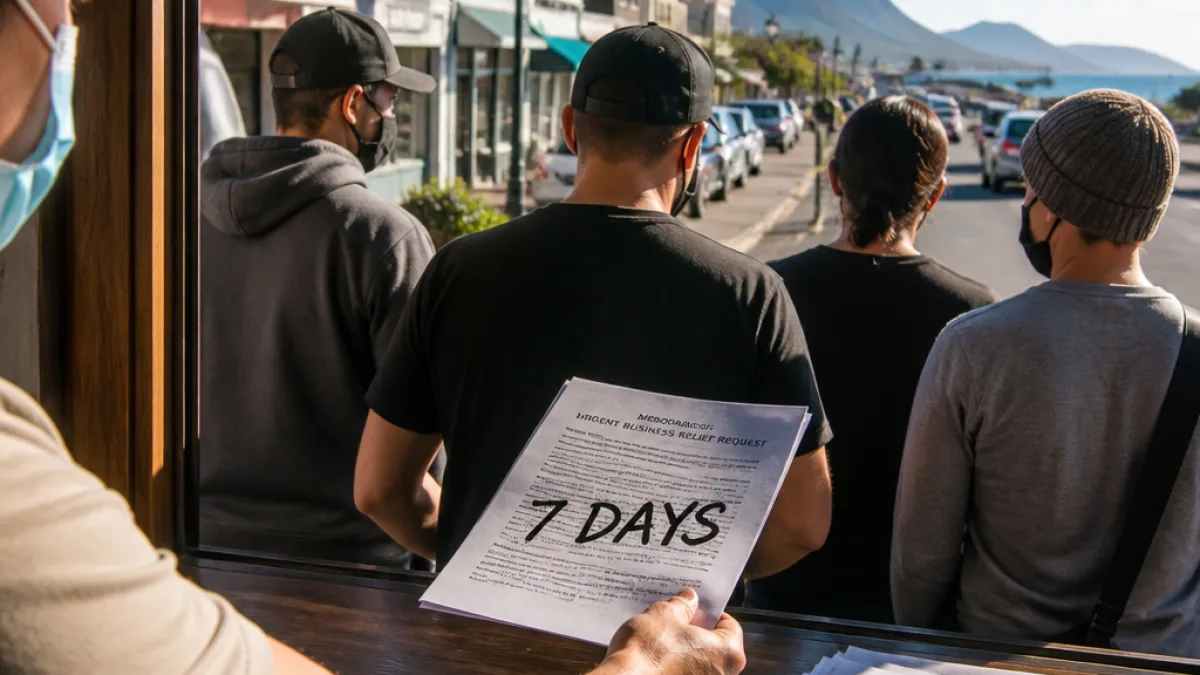
Operation Dudula hands memorandum to Hermanus businesses, sets seven-day deadline
HERMANUS — Leaders of Operation Dudula presented a written memorandum to several Hermanus business owners on 31 July, demanding that local employers prioritise South African citizens when hiring and accept CVs from local applicants within a seven-day period.
The group, which describes itself as an anti-migrant organisation and is registered as a political party, conducted a peaceful protest and personally handed the memorandum to owners, organisers said. The memorandum cites national labour and immigration laws, including the Employment Services Act and the Immigration Act 13 of 2002, as the legal basis for its demands.
At the protest one of the organisation’s leaders told proprietors that a foreign national should be employed only where transfer of skills applies or where a rare skill is needed. He also argued that documentation such as a passport or visa alone does not automatically entitle a foreign national to work in the local fishery sector.
“Every employer who wishes to employ a foreign national must do so only [on] a transfer skill basis or unless it’s a rare skill,”
The memorandum was reportedly signed by local employers and the protest leaders. Operation Dudula said regional leaders will deliver CVs from local South African applicants to businesses within the seven-day window they have set.
Local reaction and economic context
A Zwelihle resident told Hermanus Times that losing his job during the Covid-19 pandemic left him struggling to recover financially. He described a colleague of foreign descent who found work in 2021 after taking a pay cut and said he could not afford to accept a similar reduction because he has dependants.
“I worked with [my colleague] and when we lost our jobs, he got a new job at a panel beater in Cape Town and he is struggling to even pay for electricity because he took a paycut,”
The resident added:
“I have the skills to work there too, but I can’t take a pay cut because I have a family to feed and the money is below minimum wage. How is that not exploiting someone and their skills?”
Those comments underline tensions in a town where tourism, fisheries and small businesses are major employers and where informal and formal labour markets intersect. The memorandum’s call to prioritise locals raises immediate practical questions for employers about compliance with labour and immigration law, recruitment practices and the rights of documented foreign workers.
What Operation Dudula demanded
- Priority to be given to South African nationals when filling vacancies.
- Employers to accept CVs from local applicants delivered by regional leaders within seven days.
- Reference to the Employment Services Act and Immigration Act 13 of 2002 as the legal basis for demands.
| Demand | Legal basis cited |
|---|---|
| Prioritise South African nationals | Employment Services Act |
| Limit foreign national employment to transfer/rare skills | Immigration Act 13 of 2002 |
Operation Dudula’s approach in Hermanus echoes similar actions elsewhere where the group has targeted workplaces and public spaces. In Hermanus, local employers who signed the memorandum will face the organisation’s seven-day timetable for consideration of local candidates, organisers said.
There was no immediate comment in the source reporting from municipal officials, labour inspectors, the Department of Home Affairs or SAPS about the memorandum or any planned follow-up enforcement. The memorandum itself and the leaders who presented it framed the action as lawful, pointing to specific legislation regarding employment of foreign nationals.
The situation places local business owners in a difficult position: balancing obligations under labour and immigration law, the operational needs of their businesses, and community pressure to create work for local residents. For many town residents still recovering from pandemic job losses, the dispute highlights the fragile economic recovery and the challenges of securing work at sustainable wages.
How businesses, municipal authorities and labour and immigration regulators respond in the coming days will determine whether the protest remains a symbolic action or triggers formal inspections, legal challenges or further mobilisation by community groups.