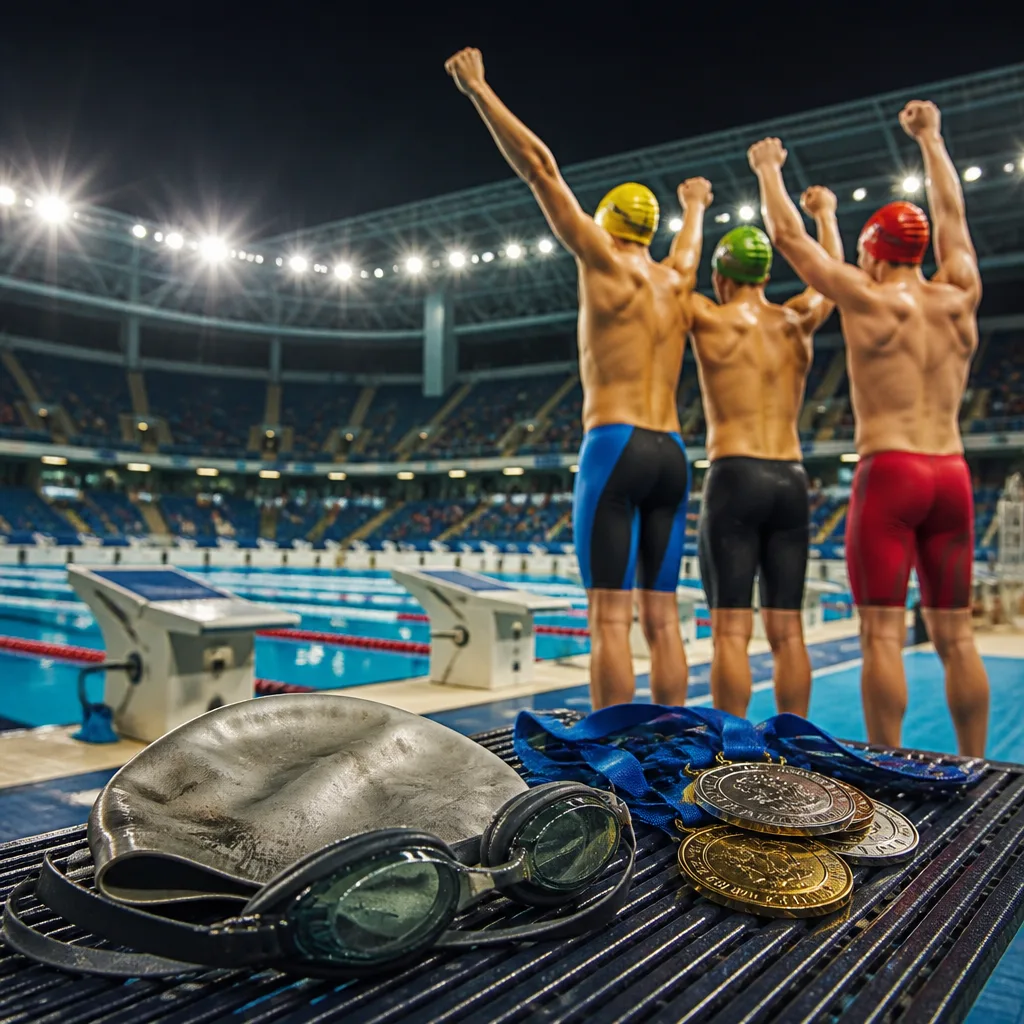
Chad le Clos admitted his body is not recovering as it once did after a gruelling Glasgow Commonwealth Games campaign that nonetheless added three relay medals to his remarkable haul.
Legacy, limits and a rising class
The 34‑year‑old, whose relay medals in Glasgow took his career Commonwealth total to 21, said this edition highlighted both the twilight of his own individual dominance and the arrival of a potent new cohort of South African swimmers.
One figure who emerged as the meet’s standout was Pieter Coetzé. Coetzé, who was six when Le Clos won his first Commonwealth medal in Delhi in 2010, collected six medals in Glasgow — including three backstroke golds — and pushed close to the 100m backstroke world record. Le Clos framed Coetzé’s performance as part of a wider national depth that could change expectations for the Olympic stage.
“I’m not recovering the same as I was even four years ago, so I can’t actually go back‑to‑back. This week was physically the hardest week I’ve ever done — and that’s not because of training, I can’t train any harder — it’s just that the body is not recovering [like it used to],” Le Clos said.
Le Clos described racing nine times in six days as unexpectedly punishing and conceded he must adjust how he approaches programme selection and recovery if he is to continue. For the first time in five Commonwealth appearances he did not reach an individual podium in Glasgow, underscoring the physical cost of a dense event schedule.
Relay hope and Olympic outlook
Even so, Le Clos believes there are tangible prospects for South Africa at Los Angeles 2028, particularly in the men’s 4x100m medley relay. He singled out a group of swimmers who could form the backbone of future teams: Michael Houlie, Chris Smith, Aimee Canny, Lara van Niekerk and Calvyn Justus.
- Le Clos — 34 years old, 21 Commonwealth medals.
- Team South Africa (class of 2026) — record 22 Commonwealth medals, 18 in able‑bodied events.
- Pieter Coetzé — six medals in Glasgow, including three backstroke golds.
The Glasgow results suggest South Africa’s springboard of talent is deeper than in recent cycles. No South African swimming team has yet won more than three medals at a single Olympics, but the 2026 cohort has been touted as capable of improving on that benchmark at LA28.
| Item | Figure |
|---|---|
| Le Clos Commonwealth medals | 21 |
| South Africa medals in 2026 (total) | 22 |
| South Africa medals in 2026 (able‑bodied) | 18 |
What this means for selection and preparation
Le Clos’s frank assessment about recovery will shape conversations around event scheduling, periodisation and relay construction in the next two years. His experience also offers a template for transitioning leadership in the pool: veterans can still contribute, particularly in relays, while younger stars shoulder individual expectations.
For supporters and selectors, Glasgow offered both reassurance and a challenge. The emergence of athletes such as Coetzé provides a genuine platform for medals beyond relays, but harnessing that potential will demand careful management of programmes and athlete load to avoid burnout and to peak for Paris‑cycle targets like LA28.
There is still time for Le Clos to adapt and play a part — perhaps most usefully as an experienced relay component and a mentor — but his comments underline the blunt arithmetic of elite sport: age and recovery are real variables that alter how an athlete is deployed.
Whatever the route taken, Glasgow confirmed South African swimming has replenished itself. The conversation now shifts to whether that talent can be organised and delivered into Olympic success in two years’ time.