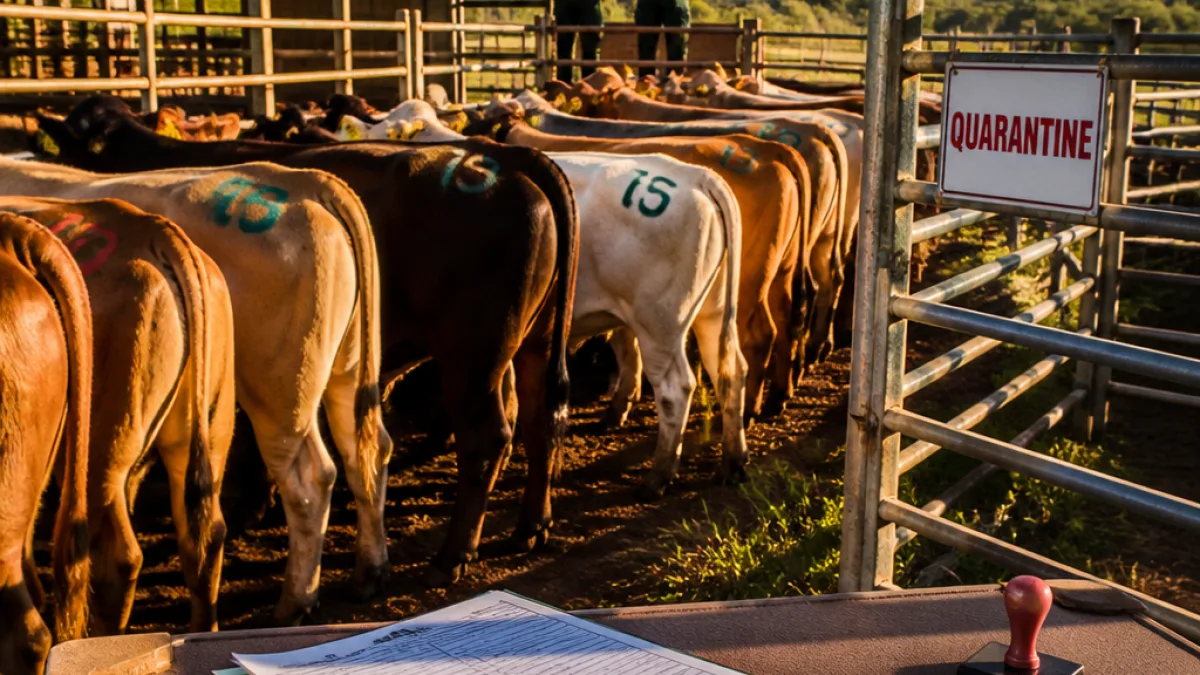
The Mpumalanga Department of Agriculture, Rural Development, Land and Environmental Affairs (MP DARDLEA) has attributed a number of new foot‑and‑mouth disease (FMD) infections to cattle purchased at auctions whose disease status was not verified, and warned farmers to exercise greater vigilance when buying or moving livestock.
Officials urge checks before buying or transporting animals
MP DARDLEA reminded farmers that the origin and destination of any animals being moved should share the same FMD or other controlled‑disease status. The department also highlighted that animals from quarantined farms must go directly to abattoirs under a veterinary permit, and that only animals vaccinated in line with the prescribed requirements should be moved.
Farmers were advised to contact their nearest veterinary officials before purchasing or transporting animals to avoid bringing infected stock onto their farms. The department linked several new infections to cattle bought at auctions whose health status had not been confirmed.
- Check provenance: confirm the disease status of origin and destination before moving livestock.
- Use veterinary routes: move quarantined animals to abattoirs only with a veterinary permit.
- Vaccination compliance: only relocate animals vaccinated according to requirements.
- Seek local veterinary advice: call nearest veterinary services when in doubt.
Vaccination campaign reaches a major milestone
MP DARDLEA reported that the province’s vaccination campaign has now inoculated 699 682 animals since it began four months ago. The campaign aims to reach 80% of Mpumalanga’s estimated 1.9 million livestock population — roughly 1.5 million animals — by December or early next year, according to ministerial task team figures cited by the department.
| Measure | Number |
|---|---|
| Animals vaccinated to date | 699 682 |
| Provincial livestock (estimated) | 1.9 million |
| Vaccination target (80%) | ~1.5 million |
| Cattle culled to control spread | 33 222 |
The department said vaccinations will be extended to other species, such as goats and pigs, once those populations are assessed and identified as high risk in specific areas.
Border districts and weekly inspections
Veterinary services remain on high alert in several district municipalities where infections have been reported, notably Thaba Chweu, Victor Khanye and Emalahleni. Farmers living alongside the Kruger National Park border were reminded to present livestock for weekly inspections at local dip tanks. The department noted the park’s buffalo population can carry FMD and poses a persistent infection risk to neighbouring herds.
So far, culling measures have been employed in affected herds, with 33 222 cattle destroyed to contain outbreaks.
Practical steps for farmers
MP DARDLEA’s guidance to farmers can be summarised as actionable steps:
- Confirm the FMD status of any animals before purchase; avoid auctions where status is unknown.
- Coordinate movements with veterinary services; do not move animals without permits when required.
- Present livestock for regular inspections where weekly dip‑tank checks are mandated, especially on the Kruger border.
- Report sudden drops in production, mouth lesions or lameness to veterinary officials immediately.
The department’s warnings underline the balance authorities must strike between protecting livelihoods and containing a contagious livestock disease that threatens both commercial and smallholder farmers. With vaccinations ongoing and surveillance heightened in hotspot districts, officials say strict farm‑level biosecurity and verified sourcing remain central to preventing further spread.
MP DARDLEA emphasised that farmers uncertain about the status of animals for sale or movement should contact their nearest veterinary office for advice and assistance.