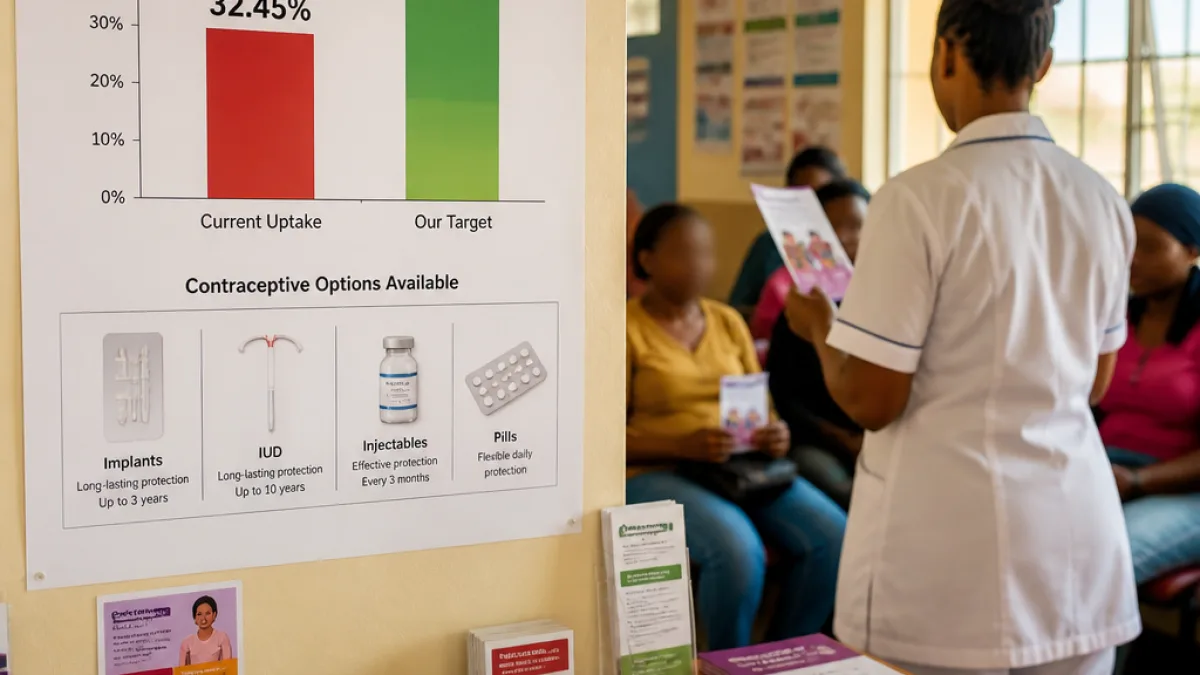
Johannesburg. Gauteng’s provincial health department has confirmed that only 32.45% of women of reproductive age accessed contraceptive services in the first quarter of the 2026/27 financial year, well short of the department’s quarterly target of 43%.
Low uptake linked to unintended pregnancies
The department said the shortfall persists despite contraception being available free of charge at public clinics, community health centres, hospitals and mobile health services across the province. It warned that low contraceptive uptake is a major driver of unintended pregnancies in Gauteng.
“According to available data, an estimated 75% of unintended pregnancies in South Africa are linked to low contraceptive use.”
The health department noted that while termination-of-pregnancy services remain an important part of reproductive healthcare, many of these cases could be avoided if eligible women accessed and used available contraceptive methods.
Services on offer and barriers to use
The department listed a range of free contraceptive options available at public facilities, emphasising that choice is not the constraint. These methods include:
- Long-acting reversible contraceptives: Subdermal Implanon and intra-uterine devices including the Copper T;
- Injectables: Nur-Isterate and Depo-Provera;
- Oral contraceptives: Triphasil, Microval and Nordette.
Despite this range, the department acknowledged that misconceptions and fears remain important barriers. Many women reportedly cite concerns about side effects and potential infertility — concerns the department linked to inadequate knowledge and misinformation about contraceptive options.
Numbers and recent service delivery
During the 2025/26 financial year the department said it provided contraceptive services to 2,915,945 women of reproductive age. But the proportion of eligible women accessing services in the first quarter of 2026/27 did not meet the provincial target, prompting the department to call for renewed awareness and community-level engagement.
| Indicator | Quarter 1 (2026/27) | Provincial target |
|---|---|---|
| Proportion of eligible women accessing contraceptive services | 32.45% | 43% |
What this means for women and health services
For individual women, low contraceptive uptake increases the likelihood of unintended pregnancies and the subsequent demand for termination services, antenatal care and social support. For public health services, it carries implications for resource planning: higher-than-expected demand for termination procedures, post-abortion care and associated reproductive health services places pressure on personnel and facilities.
The department urged women and girls of reproductive age to make use of free services to prevent unintended pregnancies and improve reproductive health outcomes. It also stressed the need for community-based education to counter myths about contraceptives and for healthcare workers to offer counselling that addresses concerns about side effects and fertility.
Practical information for residents
- Contraceptives are free at public clinics, community health centres and hospitals across Gauteng, and at designated mobile health services.
- Women with concerns about side effects should speak to a nurse or clinician at their nearest facility for counselling and to explore alternative methods.
- Choice on Termination of Pregnancy services remain available under the act at public facilities; those seeking information should contact their local health clinic for referral details.
The provincial health department said it will continue outreach and information campaigns to improve uptake and reduce unintended pregnancies, while maintaining termination services as part of comprehensive reproductive healthcare.
Thabang Diale, Gauteng correspondent.