Province targets commercialisation and youth participation in grain sector
The Eastern Cape government has launched a Grain Commercialisation Chapter that will direct R80 million towards supporting emerging grain and oilseed farmers to scale operations and access sustainable markets.
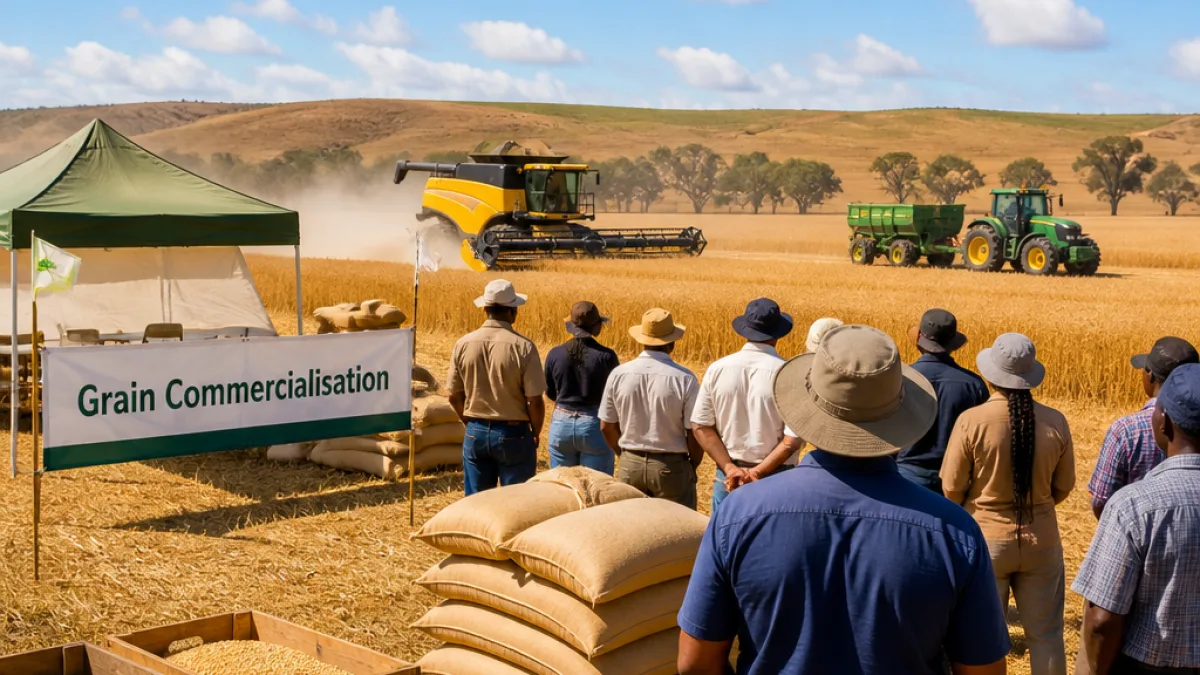
The initiative was announced at a Harvest Day held on Sonskyn Farm in the Elundini Local Municipality. Officials from the provincial Department of Agriculture, farmers and representatives of the agricultural value chain attended the event to showcase recent production and discuss how to commercialise smallholder grain enterprises.
The Grain Commercialisation Chapter sits within the department’s Agriculture Commercialisation Programme and forms part of measures outlined in the province’s 2026/27 budget and policy speech. In March, Eastern Cape MEC for Agriculture Nonceba Kontsiwe earmarked R80 million for the grain and oilseeds value chain to expand production across 24 000 hectares.
According to the department, the funding will be used to identify promising emerging farmers and provide support that includes production inputs, technical assistance and market access so they can scale beyond subsistence levels and build viable commercial enterprises.
The Harvest Day highlighted the commercial potential among young farmers. The event featured 21-year-old Iviwe Sondlo, who leases Sonskyn Farm and, together with a relative, has planted 47 hectares of maize. The farm already sells grain to regional agribusinesses, demonstrating an existing link to formal markets.
- Allocation: R80 million for grain and oilseeds in 2026/27.
- Target area: 24 000 hectares across the province.
- Focus: production scaling, value-chain support and market access for emerging farmers.
Farmers at the launch were accompanied by representatives from the department who inspected the maize harvest on Sonskyn Farm, underscoring the department’s aim to move farmers up the value chain by linking production with buyers such as feed mills and grain processors.
Officials describe the approach as selective: the department will identify farmers with demonstrated potential and provide targeted support to expand their operations and create employment opportunities. The model emphasises both production increases and the need to integrate farmers into existing commercial supply chains.
The provincial focus on grains and oilseeds responds to broader food-security and rural-development priorities. By supporting production on thousands of hectares, the programme aims to boost local food supplies, create work in farming communities and strengthen upstream and downstream agribusinesses.
At the Harvest Day organisers emphasised the role of young and emerging farmers in revitalising the sector. Sondlo’s example was presented as proof that young people, with access to land and markets, can run commercially viable operations and supply regional agribusinesses.
| Item | Detail |
|---|---|
| Funding allocated | R80 million |
| Targeted area | 24 000 hectares |
| Example farm | Sonskyn Farm, Elundini — 47ha maize (leased by a 21-year-old farmer) |
Practical questions remain about how resources will be channelled, the types of support to be prioritised and the mechanisms to guarantee market access. The department’s Agricultural Commercialisation Programme typically combines inputs, extension services and facilitation of offtake agreements, but details of how the R80 million will be disbursed were not released at the Harvest Day.
For emerging producers, the critical issues will be access to timely inputs, mechanisation and secure buyers. Agribusiness partners who can guarantee purchase contracts — as some local mills and feed companies have done in instances cited at the event — will be central to ensuring farmer income and programme sustainability.
As the Grain Commercialisation Chapter moves from launch to implementation, farmers and industry representatives will be watching for clear operational plans, transparent allocation processes and evidence that new commercial producers can access the markets needed to make the transition viable.
This initiative offers a targeted attempt to convert production potential into long-term economic opportunity for rural communities in the Eastern Cape, with youth participation an explicit priority.