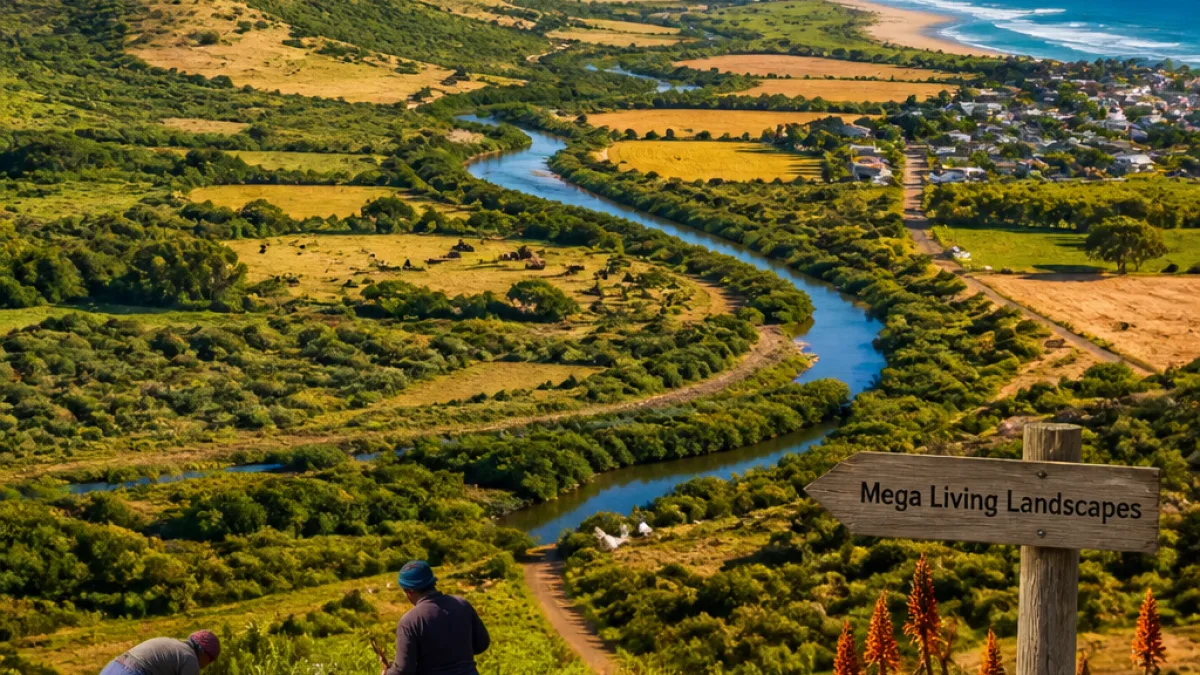
The Eastern Cape sits at the centre of plans to apply a Mega Living Landscapes approach that seeks to reconnect protected areas, communal and private land, towns and ecological corridors. Proponents say the model could restore ecosystems, support research and conservation, and create more inclusive livelihood opportunities for communities that live alongside biodiversity-rich areas.
Why the province matters
South Africa is among the world’s most biodiverse countries and contains three globally recognised biodiversity hotspots. The Eastern Cape stands out not just for individual species, but for the breadth of habitats it contains: fynbos, forest, grassland, savanna, Nama-Karoo and the Succulent Karoo. The province also hosts important river systems and thicket ecosystems that are globally distinctive.
Its coastline is a meeting place of oceanic influences, where the warm Agulhas Current encounters cooler southern waters. This marine transition creates a diverse overlap of species and habitats — from rocky shores, estuaries and sandy beaches to offshore reefs, islands and productive bays — which together underpin potential for conservation, tourism and a sustainable coastal economy.
Balancing conservation and communities
International experience shows a recurring problem: many of the planet’s most biodiverse regions are inhabited by communities that remain economically marginalised. Conservation value does not always translate into local benefit. The Mega Living Landscapes idea emphasises linking landscapes and people so that the costs and benefits of protecting biodiversity are distributed more equitably.
In practical terms for the Eastern Cape, that means considering how protected areas, communal land and private properties can be managed together with towns and economic activity to restore ecological processes while expanding livelihoods linked to tourism, research and sustainable resource use.
Where the approach could make a difference
Conservation advocates highlight several practical advantages for the province:
- Restoring ecological corridors between reserves to support species movement and resilience.
- Integrating coastal and terrestrial planning to protect estuaries, reefs and shoreline habitats.
- Creating revenue streams from responsible tourism, research partnerships and sustainable fisheries.
- Building capacity in local communities to manage natural resources and benefit directly from conservation efforts.
These measures are presented as complementary to traditional protected-area management, rather than replacements for it.
Biological and economic value
Conservationists argue that the province’s ecological diversity is not just a natural asset but an economic one. A healthier, better-connected natural landscape can support jobs in ecotourism, guide services, scientific research and sustainable harvesting, while improving ecosystem services such as water regulation and coastal protection that benefit towns and agriculture.
| Biome/Feature | Significance |
|---|---|
| Fynbos | High plant endemism and global conservation value |
| Succulent Karoo & Nama-Karoo | Unique succulent-rich deserts and semi-deserts |
| Thicket & forest | Distinctive regional ecosystems with endemic fauna |
| Coast & marine transition | Overlap of warm and cool currents supports diverse marine life |
Practical considerations for implementation
Applying a Mega Living Landscapes model will require co-operation between multiple stakeholders: national and provincial conservation bodies, local municipalities, traditional authorities, private landowners, research institutions and community organisations. Planning will need to address land-use compatibility, tenure complexities on communal land, and mechanisms to ensure benefits reach local households.
Funding, capacity-building and long-term governance arrangements are likely to determine success. Where conservation projects have faltered in the past, shortcomings have often involved unclear benefit-sharing, limited community participation and insufficient investment in local skills and infrastructure.
What to watch next
Stakeholders in the Eastern Cape will be watching how national and provincial authorities, together with conservation NGOs and local communities, develop practical proposals. If implemented with meaningful local participation and clear benefit mechanisms, the Mega Living Landscapes approach could provide a model for reconciling biodiversity protection with social and economic development in the province.
For residents and local leaders, the challenge will be ensuring that conservation planning is not only ecologically ambitious but also socially just, giving communities a measurable stake in the future of the landscapes they live within.