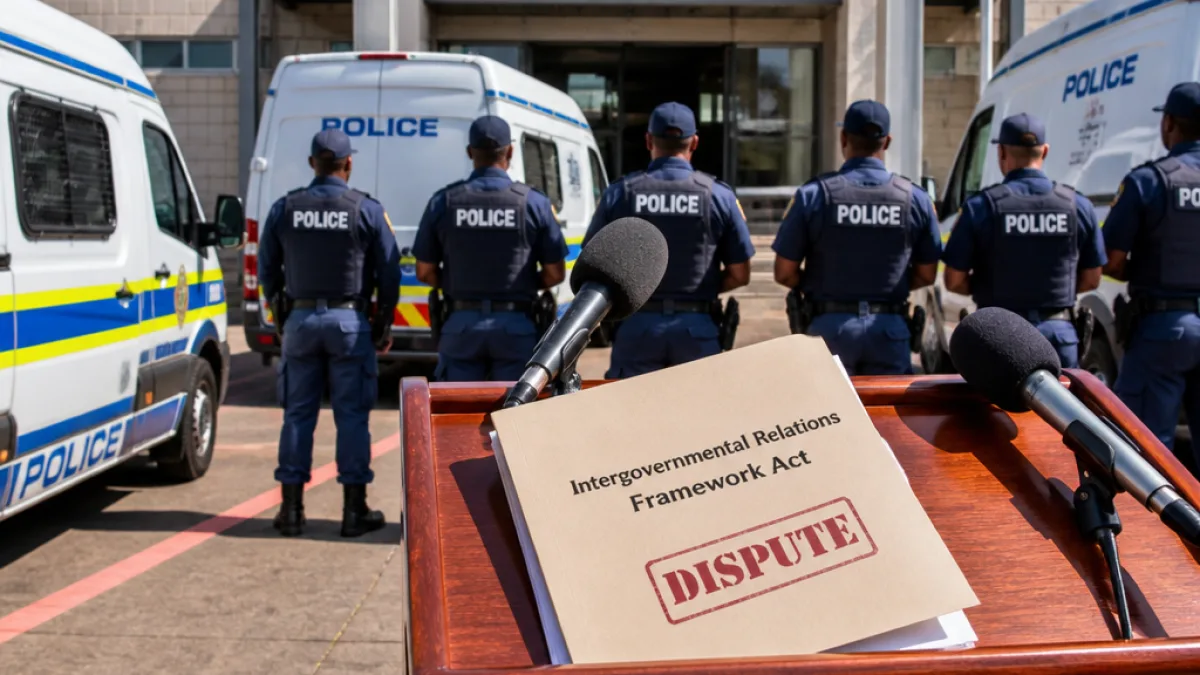
Cape Town Mayor Geordin Hill‑Lewis has formally declared an intergovernmental dispute with Acting Police Minister Firoz Cachalia, escalating a long‑running battle over whether the City’s Metro Police should be allowed to carry out criminal investigations.
City pursues mediation under national framework
The dispute was lodged under the Intergovernmental Relations Framework Act during an announcement at the City’s Law Enforcement Advancement Plan (LEAP) base in Bishop Lavis on Monday. The mayor spoke alongside Mayco member for Safety and Security JP Smith.
Under the Act the matter must now proceed to mediation between the City and the Acting Minister in an attempt to resolve the disagreement without litigation. If mediation fails, the process could move to court, the City said.
What the City wants and why
The core demand is that Metro Police officers be empowered not only to arrest and confiscate illegal firearms, but also to gather evidence, interview witnesses and compile complete dockets for direct submission to prosecutors in crimes involving illegal firearms, gangs and drugs.
The City argues that the current arrangement — in which Metro Police hand over cases to the South African Police Service (SAPS) for investigation — frequently results in weak follow‑through and few convictions. According to the mayor, City officers remove about 400 illegal firearms from Cape Town’s streets every year, yet only around 5% of these incidents lead to convictions.
“We refuse to accept that communities must live in daily fear of gang, gun and drug crime,” the mayor said.
Hill‑Lewis made clear the City is not seeking to replace or compete with SAPS but to provide additional capacity, saying national police are under severe pressure and that Metro Police are already trained and equipped with technology that could help build stronger cases.
Legal and political context
The move follows repeated attempts over several years by the City to persuade national authorities to grant expanded powers. The municipality criticised the recently tabled SAPS Amendment Bill for failing to address investigative powers for Metro Police, calling the omission a missed opportunity.
By invoking the Intergovernmental Relations Framework Act the City aims to force a formal negotiation channel. Mediation provides a structured environment to test legal, operational and constitutional arguments about the division of policing responsibilities between local and national spheres.
- Who lodged the dispute: Mayor Geordin Hill‑Lewis and the City of Cape Town.
- Respondent: Acting Police Minister Firoz Cachalia.
- Next step: Mediation under the Intergovernmental Relations Framework Act; court action only if mediation fails.
Practical implications for Cape Town communities
If mediation leads to changes that allow Metro Police to compile dockets and investigate certain crimes, the City says prosecutions should improve because evidence would be collected and packaged with continuity from initial arrest through to prosecution. That could shorten case handovers and reduce evidential gaps that prosecutors cite for withdrawal or poor outcomes.
However, any expansion of powers raises operational and oversight questions. National government will assess whether Metro Police have the necessary training, independence, forensic access and institutional checks to conduct criminal investigations without undermining the constitutional role of SAPS and the National Prosecuting Authority.
| Item | Figure (City estimate) |
|---|---|
| Illegal firearms removed annually | 400 |
| Estimate of resulting convictions | ~5% |
For residents watching the process, the immediate question will be whether mediation produces a workable agreement that strengthens frontline policing without creating duplication, or whether the dispute slides into a protracted legal fight that delays any operational improvements.
The dispute is a significant test of intergovernmental co‑operation on one of Cape Town’s most pressing concerns: reducing gang and gun violence in communities long affected by those crimes.