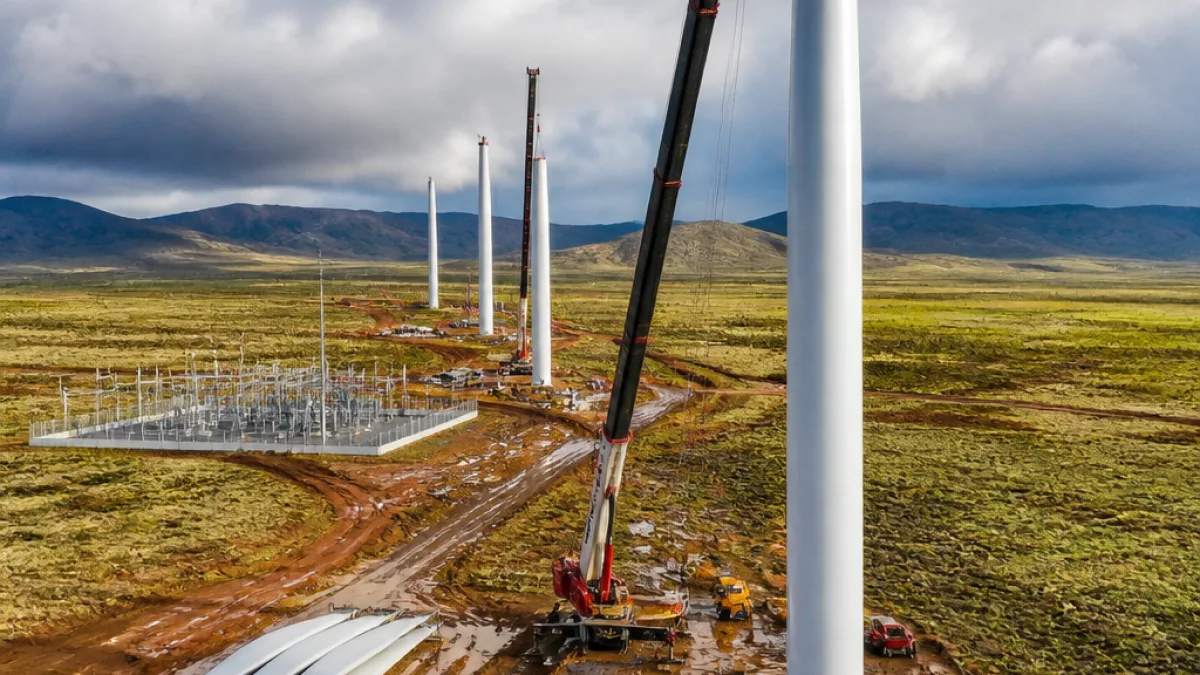
The 420 MW Northern Cluster of wind farms under construction across the Karoo near Murraysburg and Richmond is still expected to reach commercial operation before the end of 2026 despite heavy rainfall that disrupted site activity earlier this year, Engineering News reported.
Three projects, one shared grid connection
The development comprises three 140 MW facilities — Khangela, Umsinde and Ishwati Emoyeni — being delivered by independent power producer Anthem in partnership with co-shareholder Reatile Renewables. The three projects share a main transmission substation and will be linked by some 70 km of self-built 132 kV powerlines to feed output into the national grid.
The combined investment across the cluster is almost R15-billion. According to the report, construction has generated more than 1 400 jobs and the operational phase is expected to support just over 50 permanent positions. The developers also expect to channel multimillion-rand contributions into local area development over the next 20 years.
Long-term offtake agreements underpin project
All three wind farms are supported by commercial and industrial power purchase agreements (PPAs) of between 20 and 25 years that were finalised in 2024 with private offtakers. The Khangela output is contracted to Richards Bay Minerals, Umsinde’s electricity to precious-metals group Sibanye-Stillwater, and Ishwati’s output to electricity trader NOA.
Anthem chief executive James Cumming told Engineering News that, despite a force majeure declaration by contractors after heavy rains between February and June, he remained optimistic that the cluster could meet fourth-quarter 2026 commercial operation dates.
“I am optimistic that commercial operation dates in the fourth quarter of 2026 remain within reach,”
Equipment and construction partners
The three sites will be equipped with 96 Vestas V163 turbines, each rated at 4.5 MW, supplied by the manufacturer Vestas. South African construction group Raubex was contracted for parts of the build, the report said.
- Capacity: 420 MW (3 × 140 MW)
- Turbines: 96 × V163 @ 4.5 MW
- Transmission: Shared MTS and ~70 km of 132 kV lines
- Investment: Almost R15-billion
- Jobs: >1 400 construction; >50 operations
Local implications for the Northern Cape
For towns on the border of the Western and Northern Cape such as Murraysburg and Richmond, the project represents both immediate and long-term economic opportunity. Construction activity brings short-term work for local contractors, transporters and suppliers, while sustained community investment and the small operational workforce will contribute to ongoing local spending. The project’s reliance on self-built transmission lines and a dedicated substation means significant engineering and logistics work taking place on Karoo farmland.
Developers have indicated multi-decade commitments to local area development projects. That commitment will be watched closely by municipal authorities, local business chambers and communities keen to ensure that promised benefits are realised beyond the construction phase.
What remains to be monitored
Key variables that will determine whether the cluster meets its commercial operation milestones include remedial works arising from the recent rains, the contractors’ ability to recover the construction programme after the force majeure period, and progress on grid integration with Eskom’s transmission network. The projects reached financial close at different times: Khangela and Umsinde in May 2024 and Ishwati in September 2024, which influenced the construction sequencing referred to in the report.
| Project | Capacity | Offtaker | Financial close |
|---|---|---|---|
| Khangela | 140 MW | Richards Bay Minerals | May 2024 |
| Umsinde | 140 MW | Sibanye-Stillwater | May 2024 |
| Ishwati Emoyeni | 140 MW | NOA (trader) | September 2024 |
Local stakeholders and residents in the Northern Cape should expect continued heavy vehicle movements during the remainder of construction: the supply and erection of 96 turbines alone involves significant logistical effort, including more than a thousand heavy truck movements referenced in the reporting. Municipal planners and roads authorities will need to manage that traffic and the wear on rural roads.
As the year progresses, forecasting from the developers and progress reports from contractors will be the clearest indicators of whether the fourth-quarter target remains viable. For now, the Northern Cluster remains one of the largest privately contracted renewable-energy investments affecting the Northern Cape this decade, with tangible implications for jobs, local infrastructure and rural economies.